Insights — 15 August 2026
Epoxy vs urethane vs polyaspartic: choosing by what hits the floor
Ask five contractors which coating is best and you will get five confident answers, each of which happens to match what that contractor prefers to install. The honest answer is that epoxy, urethane cement and polyaspartic are not ranked tiers of the same product. They are different chemistries with different tolerances, and each one is the wrong choice somewhere. A floor selected by product fashion — or by whichever name appeared in the last advertisement — is a floor selected blind.
The reliable way to choose is to ignore the product names for a moment and list what actually arrives on the slab: forklift wheels or foot traffic, hot water or road salt, sunlight or none, and how many hours the space can be out of service. Do that first and the chemistry usually chooses itself.
The three chemistries
What each system actually is
An epoxy floor is a two-component resin that cures by the reaction of a resin and a hardener. It builds thickness readily, bonds tenaciously to properly prepared concrete, carries decorative broadcasts well, and resists a wide range of chemicals. Its known limits are ultraviolet light, which ambers most epoxies over time, and cure times that stretch as temperatures fall.
Urethane cement — sometimes called cementitious urethane or PUC — is a different animal: a urethane resin blended with cement and aggregate, trowelled or poured as a dense mortar. It is the system built for punishment that destroys ordinary coatings: thermal shock from hot wash-down, steam, aggressive organic chemistry, and constant wet service. It is the default answer in commercial kitchens and food processing for a reason.
Polyaspartics are fast-curing aliphatic coatings. Their headline virtues are speed — some floors return to service the same day, conditions permitting — excellent UV colour stability, and a wide installation temperature window. Their limits are thinner films per coat and a working time that punishes slow or understaffed crews. They are outstanding topcoats and quick-turnaround systems, and a poor substitute for a thick-build body coat where one is needed.
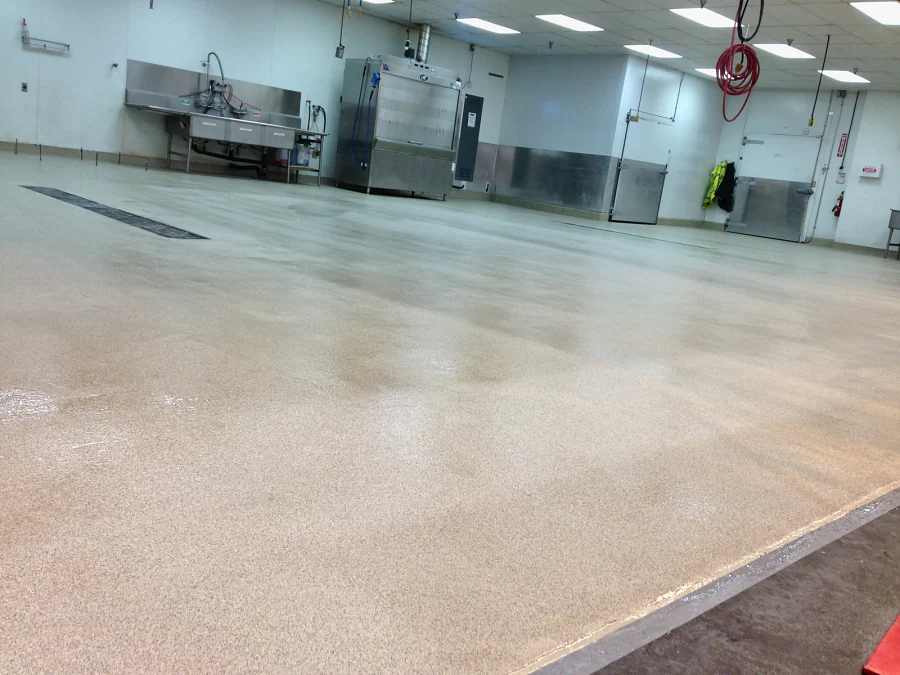
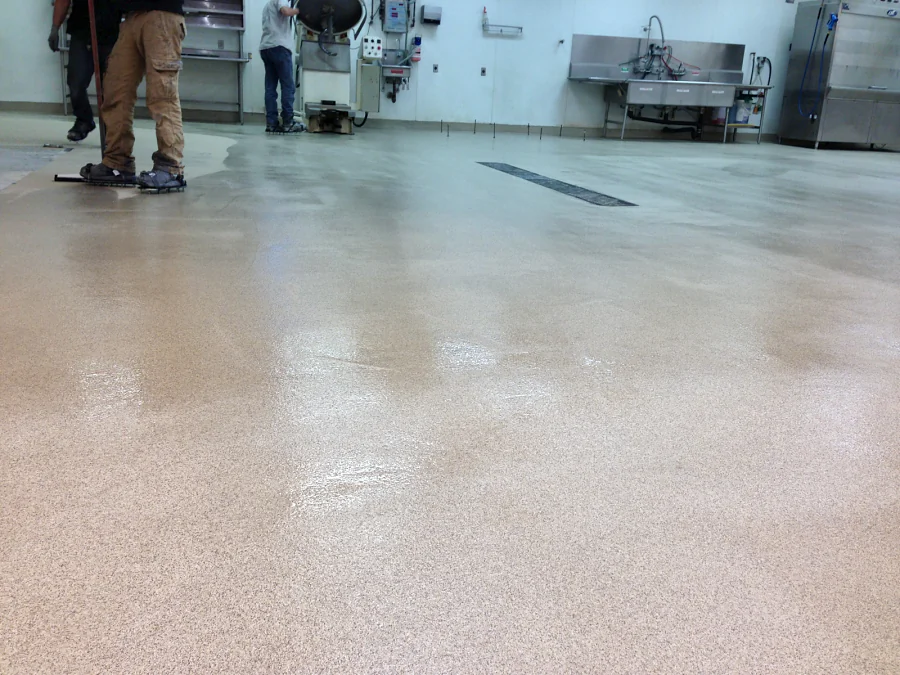
Urethane cement in service: the high-performance cementitious urethane floor with a decorative quartz finish at Costco, Abbotsford, 2013, laid to the trench drains (left and right).
Side by side
The comparison that matters
| Condition on the floor | Epoxy | Urethane cement | Polyaspartic |
|---|---|---|---|
| Heavy point loads and abrasion | Strong, especially with broadcast aggregate | Excellent — a dense mortar body | Good as a topcoat over a built system |
| Thermal shock (hot wash-down, steam) | A known failure mode | The system designed for it | Not the tool for this job |
| UV exposure and colour stability | Ambers over time | Usually topcoated anyway | Excellent — aliphatic chemistry |
| Cold or cool installation windows | Cure slows markedly | Moderate tolerance | Widest temperature window |
| Speed of return to service | Typically the slowest | Fast for what it is | The fastest, conditions permitting |
| Build thickness per application | High — the workhorse body coat | Highest — trowelled mortar | Lower — film-forming coats |
Every cell above has exceptions by product line — manufacturers publish the numbers for each system, and the datasheet for the actual product proposed is the document that governs.
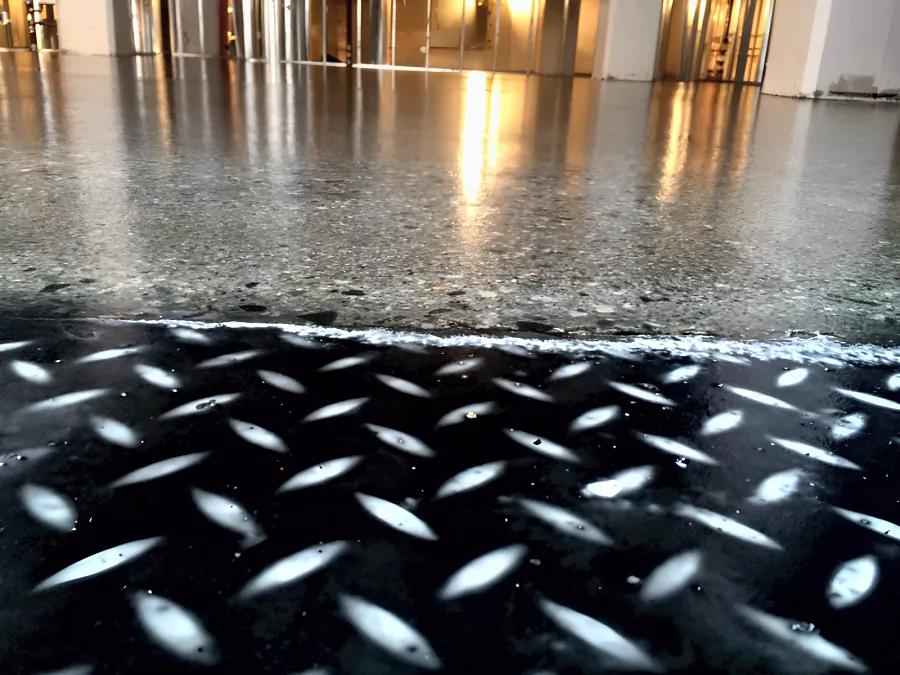
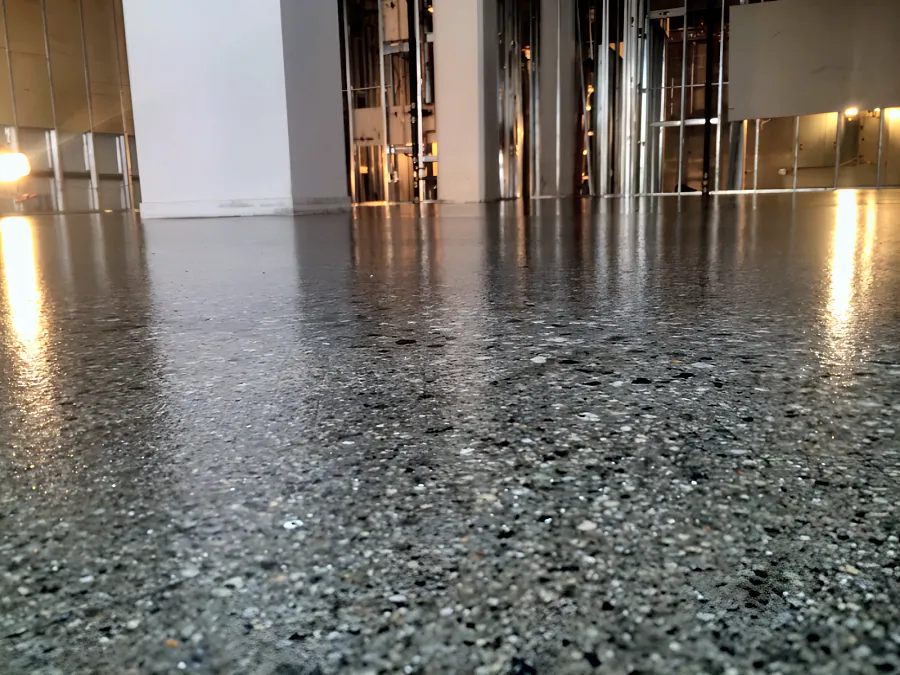
A clear epoxy and urethane coating at a Downtown Vancouver restaurant, 2014: where the clear-coated concrete meets a black diamond-pattern floor (left), and the stone in the slab under the clear coat (right).
Where each one wins
Matching system to service
A distribution warehouse floor lives under forklift wheels, drag chains and pallet corners, indoors, at a steady temperature. That is epoxy territory: a thick-build body with a hard-wearing broadcast, topcoated for cleanability. Sunlight never touches it, so epoxy's UV limitation is irrelevant, and its abrasion performance per dollar is hard to beat.
A commercial kitchen or a food processing hall is the opposite case. The floor is soaked daily, hit with hot water and cleaning chemistry, and scrubbed on a schedule. Epoxy delaminating under thermal shock is not a hypothetical there — it is the standard failure story. Urethane cement, coved up the walls and finished with falls to drain, is what survives, which is why our kitchen flooring work defaults to it in wet zones.
A residential garage or a showroom that must reopen tomorrow morning plays to polyaspartic strengths: fast cure, no yellowing where daylight reaches the slab, and a finished appearance clients like. And on many floors the right answer is a hybrid — an epoxy body doing the structural work with a polyaspartic wear coat on top, each chemistry doing the one thing it is best at. The options and their trade-offs are laid out system by system in our coating systems library.
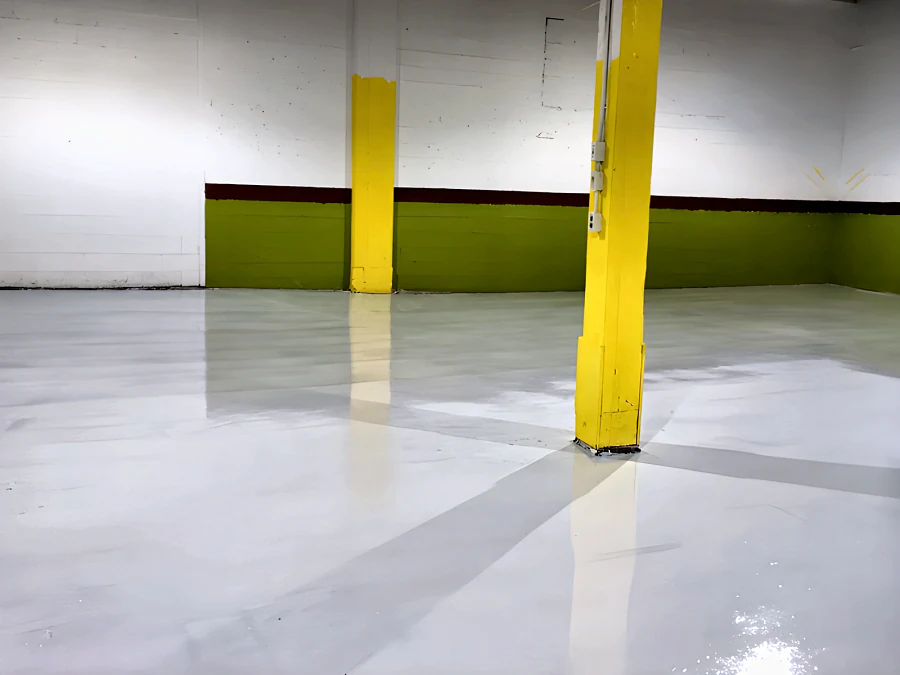
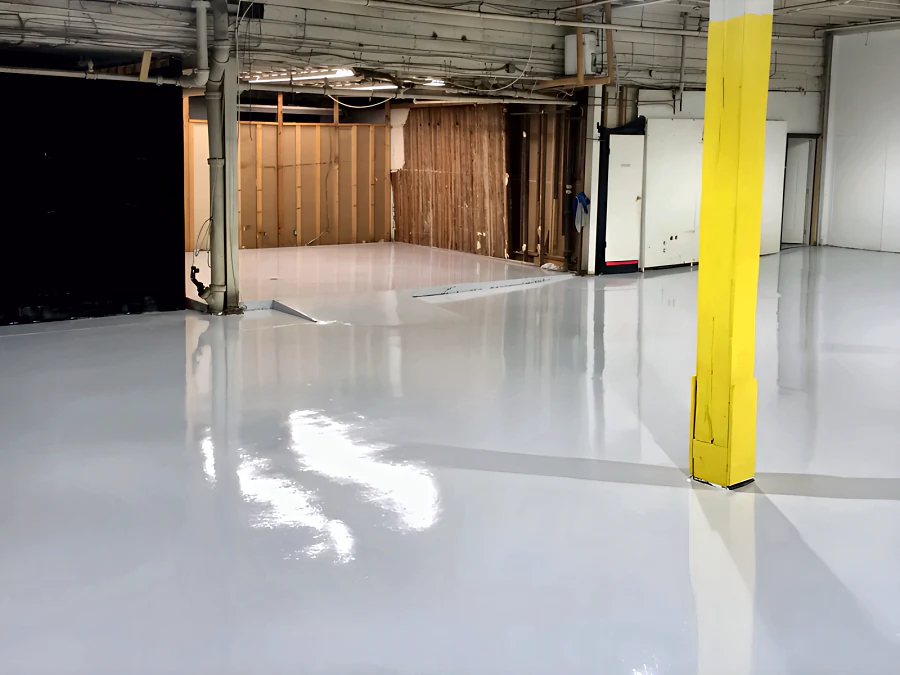
An epoxy and urethane system in service at Adventure Den, a Vancouver dog daycare, 2014, finished with a chemical-resistant urethane: round the columns by the green-painted walls (left), and through to the stair (right). More on the projects page.
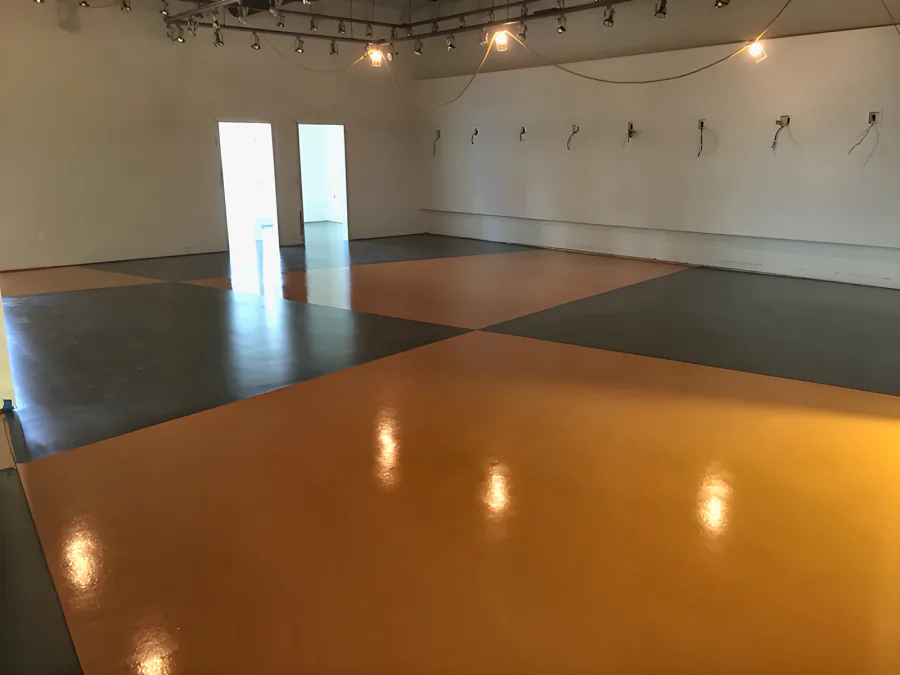
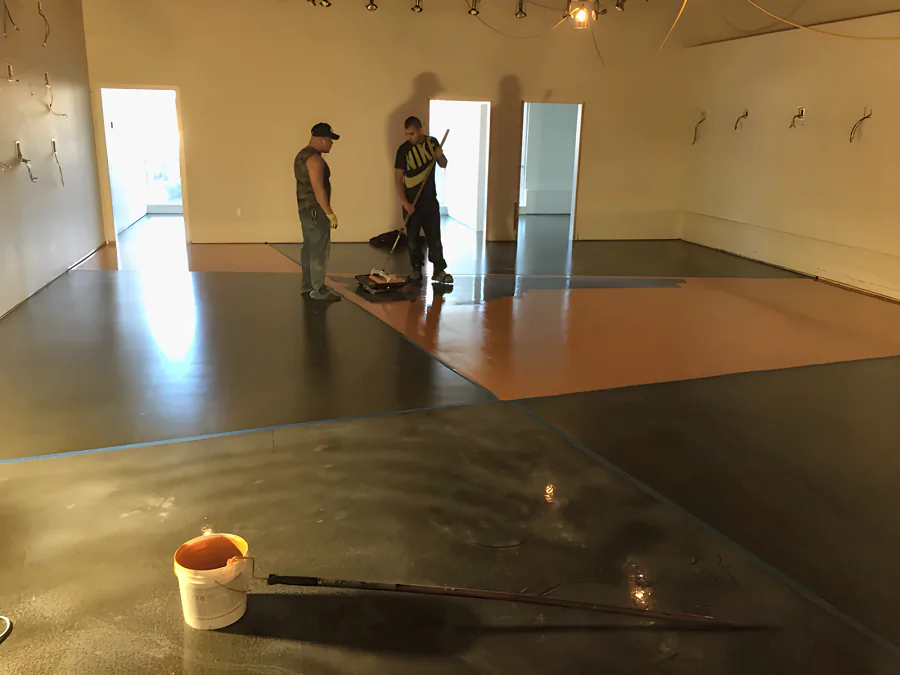
A showroom in two-colour urethane: the finished orange and charcoal sections (left), and the room masked into sections before the second colour went on (right).
Before any of this matters
The part the product cannot fix
Chemistry selection is the second decision, not the first. Every one of these systems fails the same way over a slab that was not prepared or measured:
- The slab gets tested before the system gets named.
Moisture readings at depth decide whether the floor can be coated at all, and with what. A polyaspartic over a wet slab fails just as surely as an epoxy — faster, if anything, since the film is thinner. What that testing involves is covered in what a concrete moisture test actually tells you.
- Preparation is specified, not assumed.
Diamond grinding or shot blasting to the surface profile the system's datasheet requires. No chemistry bonds reliably to a slab that was acid-etched or, worse, just cleaned.
- Repairs come before resin.
Spalls, unsound joints and moving cracks are concrete problems. Coating over them transfers the problem into the new floor.
- The datasheet's conditions are respected.
Temperature, humidity, recoat windows, maximum moisture. Installing outside them converts a warranted system into an experiment.
This is why we quote by site assessment rather than by the square foot over the phone. Two floors of identical size can differ by double once preparation, repairs and phasing are honestly counted — and the coating that goes on last is the cheapest line of the four.
Questions we get asked
Epoxy, urethane and polyaspartic FAQs
Is polyaspartic better than epoxy?
Neither is better; they solve different problems. Polyaspartics cure fast, tolerate cooler installation temperatures and hold their colour under UV, which suits garage floors and work with tight closure windows. A properly built epoxy system goes on thicker per coat and remains the reference choice for many industrial floors. The wrong question is which product wins; the right question is what the floor has to survive.
When is urethane cement worth the extra cost?
When the floor sees thermal shock or aggressive chemistry — commercial kitchens, food and beverage processing, wash-down areas where hot water or steam hits the slab. Epoxies can fail by delamination under repeated hot-cold cycling because they expand at a different rate than concrete. Urethane cement moves more closely with the slab and tolerates the abuse. On a floor that never sees those conditions, it is usually unnecessary.
Can these systems be combined?
Routinely. Many of the best-performing floors are hybrids: an epoxy body coat carrying the build and the broadcast, finished with a polyaspartic or urethane topcoat for UV stability and abrasion resistance. The systems in a manufacturer's line are designed to work together, which is one reason mixing products from different lines without approval can void the warranty.
Does the choice change the price much?
Less than surface preparation and slab condition do. Product chemistry is a real cost line, but on most projects the bigger variables are the grinding or shot blasting required, repairs to the slab, moisture mitigation if the readings demand it, and how the work has to be phased around your operations. That is why we price floors by assessment rather than quoting blind per-square-foot rates.
Keep reading
Related reading
Traffic membranes, epoxies, urethane mortars and polished concrete, compared honestly.
What a moisture test actually tells youThe measurement that predicts coating failure before it happens.
Industrial floor coatingsSystems for warehouses, plants and production floors across Metro Vancouver.
Site assessments
Send us the slab. We'll tell you what it actually needs.
Photographs and a rough area are enough to start. We'll come out, test moisture, and scope it properly.
Main (604) 968-2040 · Second (604) 230-0256 · estimating@westpacificcoatings.com