Flat roofing · liquid-applied and torch-on
Flat roofing, restored or replaced
For commercial, industrial, strata and residential buildings, there are two ways to keep a flat roof dry. Where the existing roof is sound, a ResinTech liquid-applied membrane restores it in place; where it has failed, torch-on roofing replaces it. Every roof is inspected before we price it.
What we do on flat roofs
Restore it, replace it or repair it, after we have looked at it.
Most flat-roof calls start with a leak. Whether the answer is a repair, a liquid-applied restoration or a new torch-on roof depends on the condition of the roof, not on its age, and we would rather tell you which after an inspection than sell you one before it.
Liquid-applied restoration
The ResinTech RMS membrane, fabric-reinforced over the full surface, laid over a sound existing roof or a new concrete deck.
Learn more →Torch-on roofing
New torch-on roofs, and replacement where the existing roofing has failed across the field.
Learn more →Repairs and leak assessment
Open laps, blisters, failed flashings and leaking drains found and recorded, with a straight answer on what the roof needs.
Learn more →Roofs that carry traffic
Roof terraces, walkways and rooftop parking take a traffic membrane, not a roofing membrane.
Learn more →Restore or replace
Two systems, chosen by the condition of the roof.
A liquid-applied restoration keeps the existing roofing and seals it under a new, seamless membrane. A torch-on replacement takes the old roofing off and builds a new roof in its place. Neither is the better roof everywhere: the right one is the one your roof’s condition supports.
| What it is | Two coats of ResinTech FPU polyurethane with polyester fabric between them over the full surface, under a grey PPM top membrane |
|---|---|
| The existing roofing | Stays in place as the substrate, if it is sound, dry and firmly bonded and passes an adhesion test patch |
| Where it fits | Sound roofs leaking at seams, flashings and details; new concrete roof decks |
| The details | Drains, upstands, penetrations and seams done first in FPU and fabric |
| On site | No open flame; dry, stable weather and a roof surface within the products’ temperature limits |
| What decides it | An inspection and an adhesion test patch |
| What it is | Modified-bitumen membrane sheets, heat-welded to the roof with a torch and fused at the laps |
|---|---|
| The existing roofing | Comes off on a replacement; the deck is inspected and repaired before the new roof goes on |
| Where it fits | Roofs that have failed across the field, wet or unbonded roofing, and new roofs specified in torch-on |
| The details | Flashings formed at parapets, curbs, drains and penetrations |
| On site | Open-flame hot work, planned for the building before work starts; dry weather |
| What decides it | An inspection of the roofing and the deck |
The fair comparison is two scopes priced against the same inspection. Our article on restoring or replacing a commercial flat roof sets out the questions that decide it.
Who it suits
Commercial and industrial roofs first, with the same care on a house.
Warehouses, plants, retail and office buildings come first, and their roofs are usually large, flat and carry rooftop equipment. Strata buildings follow the same process, and we can work from a depreciation report. Houses with flat roofs, and concrete roof decks over living space or a garage, are assessed the same way.
New construction is the other half: a new concrete roof deck can take the RMS membrane once it has cured, and a new roof can be built in torch-on. Roofs that people walk or drive on are a different job, which is why roof terraces, walkway routes and rooftop parking take one of our traffic membranes instead.
How an assessment works
Look first, then test, then price.
- Tell us about the roof.
Photographs, a rough area, what is on the roof now, and where water shows up inside. A call is fine; so is the form.
- Inspect it.
The drainage, the field, the seams and laps, the flashings, drains and penetrations, the rooftop equipment, any signs of wet or unbonded roofing, and the deck wherever it can be seen.
- Test, where restoration is on the table.
A small area is prepared as it would be for the full job, a patch of the RMS membrane goes down and cures, and its adhesion is checked. The existing roof type is confirmed with ResinTech at the same time.
- Put it in writing.
A scope for a repair, a restoration or a replacement, with what the roof needs before any of them, and what is not included.
- Schedule it for the weather.
Roof work goes on in dry weather, and liquid-applied work also needs the roof surface inside the products’ temperature limits.
- Hand it over.
What was installed, and photographs of it. On a liquid-applied roof, the batch numbers, film builds and weather are recorded as well.
Our rooftop work
Our own photographs, labelled for what they are.
We only publish photographs of our own work, with the system named. The membrane photograph shows ResinTech FPU and PPM, the two products in our RMS roofs, on a planter job. The deck photograph is a traffic coating on a roof that carries cars, which takes a different system from a roof that carries no traffic. Photographs of finished RMS and torch-on roofs will be added as each job is documented.
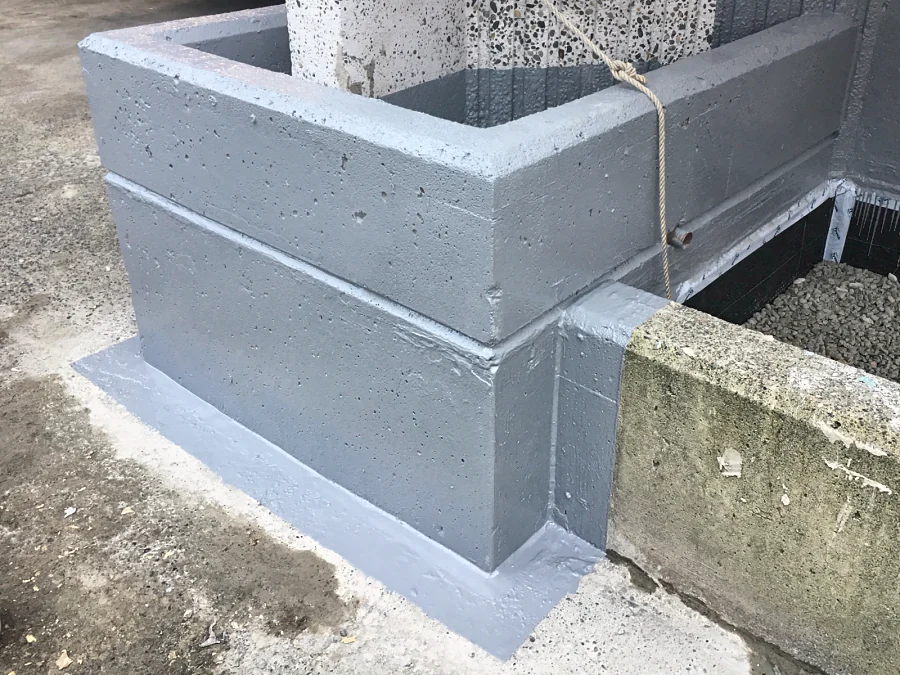
ResinTech FPU under a PPM top coat, turned up a column and carried onto the slab: the same detailing an RMS roof gets at its upstands. A planter, not a roof. See the project.
- System
- ResinTech FPU and PPM
- Work
- Planter waterproofing
- Location
- Not recorded
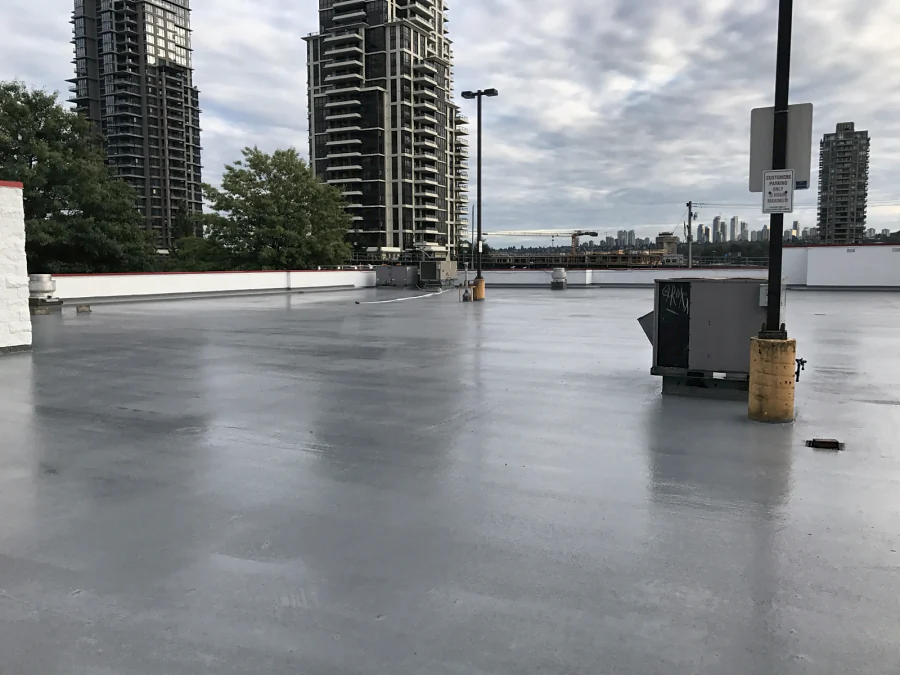
The rooftop customer parkade of a Staples store in Burnaby, recoated in Tremco Vulkem in 2017: a traffic coating on a roof that carries cars, not a roofing membrane. See the project.
- Setting
- Rooftop parkade
- System
- Tremco Vulkem 350NF/950NF/951NF
- Year
- 2017
Where we work
Flat roofing across our service area.
We assess and price flat roofs across Greater Vancouver, the Fraser Valley, the Sea-to-Sky corridor and Greater Victoria. Each city page has a short roofing section with the local picture.
Questions we get asked
Flat roofing FAQs
Do you replace flat roofs, or only coat them?
Both. Where the existing roofing is sound, dry and firmly bonded, and the roof drains, it can often be restored in place with the ResinTech RMS liquid-applied membrane after an adhesion test patch. Where the roofing has failed across the field, we replace it with a torch-on roof. The inspection decides which.
Can a leaking flat roof be restored instead of replaced?
Often, if the leaks come from seams, flashings, drains and other details rather than from roofing that has failed everywhere. Wet and failed areas are repaired first, and a test patch shows whether the membrane bonds to your roof before the full job is quoted. If the roof is not a candidate, we will tell you.
How do you choose between liquid-applied restoration and torch-on?
By the condition of the roof: whether the existing roofing is sound and bonded, whether the deck is dry, how the roof drains, how many details there are, and what the test patch shows. Where both are possible, the fair comparison is two scopes priced against the same inspection.
Do you work on houses and strata buildings?
Yes. Residential flat roofs, concrete roof decks over living space or garages, and strata buildings go through the same inspection as a commercial roof. For strata buildings we can work from your depreciation report.
Can we walk on the roof or use it as a terrace?
A roof that carries regular foot traffic or parking needs a traffic membrane rather than a roofing membrane: ResinTech PTS+ for pedestrian areas and VTS-D+ for rooftop parking. Tell us which parts of the roof are walked on and each area is specified separately.
How is a flat roof priced?
After an inspection. The size of the roof, the condition of the existing roofing, what has to come off on a replacement, the detailing at drains, upstands and penetrations, and access to the roof set the price, so we do not quote a blind rate per square foot.
When can roof work be done?
In dry weather. Liquid-applied work also needs the roof surface within the products’ temperature limits and at least 3 °C above the dew point, so in the wetter months the work is planned around the forecast.
Keep reading
Roofing guides
Restore or replace a commercial flat roof
The four questions that decide whether a roof can be restored.
Learn more →How a fabric-reinforced liquid roof membrane works
The FPU base coats, the fabric and the top membrane, layer by layer.
Learn more →A flat roof inspection checklist
Eight places to look, and what to write down before you call.
Learn more →Roof assessments
Send us the roof. We’ll tell you what it needs.
Photographs and a rough area are enough to start. We inspect it, test it where restoration is possible, and tell you what it actually needs.
Main (604) 968-2040
Second (604) 230-0256
estimating@westpacificcoatings.com