Industries — Manufacturing
Manufacturing and production plant flooring
No two production floors carry the same duty, and most carry three or four different duties within one building: forklift routes taking abrasion, machine aprons taking oil and vibration, dosing and wash areas taking chemistry and water, and assembly zones that mostly need light, lines and cleanliness. Coating a plant with one system everywhere means over-buying where duty is light and under-building where it is brutal — and the floor tells on the specification within a year, at the brutal spots.
West Pacific's approach is to map the duties first and specify zone by zone from the manufacturer lines we install — epoxy builds for abrasion, urethane cement where heat and chemistry rule, joint and repair systems where the slab itself needs work. It is the same measured-first method that runs through all our industrial flooring work, applied at plant scale.
Reading the plant
The duty map comes before the product
A useful plant specification starts with an unglamorous walk: where the wheels run and turn, what each machine sheds — oil, coolant, heat, vibration — where water and chemistry hit the floor and where they are supposed to go, which joints have been crushed by hard wheels, and where the previous coating failed. That last item is the most informative document in the building. Failure at the same spots is a signature: rising moisture here, thermal cycling there, impact at a joint line. Coating over a signature without reading it buys the same failure again.
The slab itself gets measured, not assumed — moisture at depth, soundness, contamination. Production slabs that have drunk cutting oil or process chemistry for twenty years are an honest problem: heavily contaminated zones can defeat any coating, and it is better to find them at assessment than after failure. What the moisture numbers mean is set out in our moisture testing guide; what the candidate systems tolerate is in the systems library.
Around production
Installed against the production calendar
- Zone map and phasing agreed with operations.
Which areas can come offline, in what order, for how long — built around shift patterns, weekend windows and seasonal shutdowns.
- Preparation at full standard inside each window.
Mechanical removal of failed systems and contamination, profile to datasheet, repairs and joint work before resin. Compressed windows compress the sequence, never the standard.
- Systems matched to each zone's duty.
Broadcast epoxy on the forklift routes, urethane cement at heat and chemistry, terminations sealed at every machine base and trench edge.
- Lines, zones and safety demarcation.
Walkways, exclusion zones and route markings applied as part of the system so they wear with the floor, not off it.
- Documentation per zone.
What went down where, over what readings — so the maintenance plan inherits facts, and the next recoat is scheduled rather than forced.
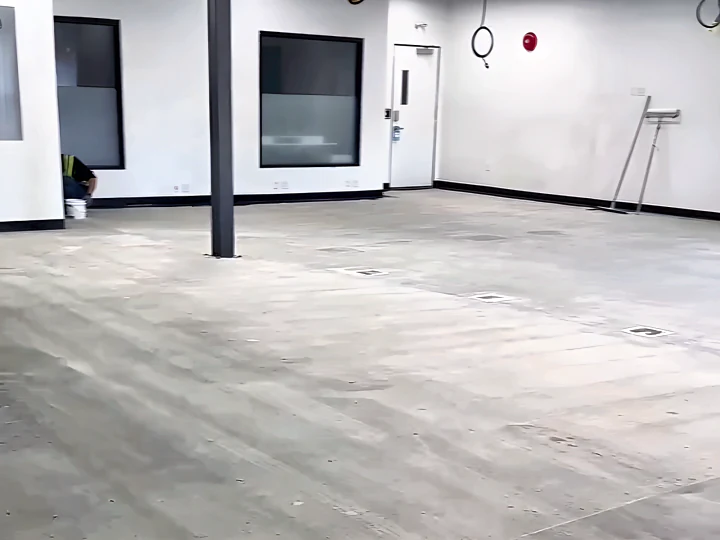
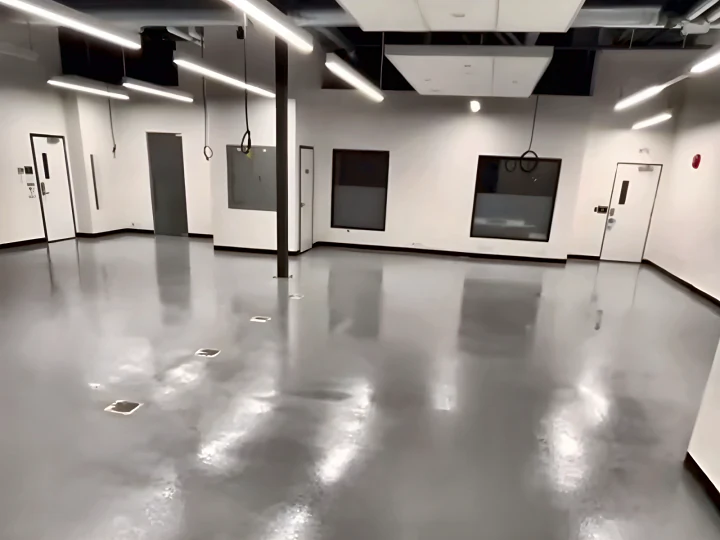
The Lush manufacturing floor before (left) and after (right), resurfaced in ResinTech TUE with Canada Gray pigment. More on the projects page.
Questions we get asked
Manufacturing flooring FAQs
How do you coat a floor the plant cannot stop using?
By sectioning and sequencing. Production floors are mapped with your operations team, split into zones that can come offline without stopping the line, and worked through on a rotation — often against weekend or seasonal shutdown windows. Fast-cure systems widen what fits in a window, always within the manufacturer's published conditions.
Our old coating keeps failing at the same spots. Why?
Repeated local failure is a signature, not bad luck. It usually points at a condition the original specification ignored: moisture rising through that part of the slab, thermal cycling at a specific machine, chemical attack at a dosing point, or joints moving under wheel impact. The fix starts with reading the failure — coating over it again with the same system reproduces it.
Can you work around fixed machinery?
Yes. Machine bases, bolt patterns and service trenches are detailed rather than avoided — the floor is terminated and sealed at each obstruction so there is no unsealed edge for chemistry and water to get under. Edges and terminations are where industrial floors start to fail, so they are treated as design details, not leftovers.
What surface preparation does an old production slab need?
Almost always more than the quote that skipped the assessment assumed. Decades of oil, coolant or process chemistry soak into concrete; failed patches and worn toppings have to come off; and contaminated zones must be identified honestly because badly soaked concrete can defeat any coating. Mechanical preparation to the specified profile, with repairs before resin, is the non-negotiable part of the job — it is covered in depth on our surface preparation page.
Site assessments
Send us the slab. We'll tell you what it actually needs.
Photographs and a rough area are enough to start. We'll come out, test moisture, and scope it properly.
Main (604) 968-2040 · Second (604) 230-0256 · estimating@westpacificcoatings.com