Industries — Static Control
ESD and static control flooring
Static damage is the failure nobody sees happen. A charge builds on a person walking across an ordinary floor, discharges through a component at a bench, and the part either dies immediately or — far more expensively — dies in the field months later as a warranty return nobody can explain. The floor is not the whole answer to that problem, but it is the part of the answer that is poured into the building and hardest to change afterwards.
West Pacific installs static-dissipative and conductive floor systems for electronics assembly, cleanroom-adjacent production, battery and energy storage work, and any operation running a formal ESD control programme. The systems come from the manufacturer lines we install across our industrial work, and the finished floor is verified by measurement rather than by assertion.
What actually controls charge
The floor is a system, not a coating
The instinct is to treat static control as a product choice — pick the dissipative epoxy from the brochure and the problem is handled. It does not work that way. A static control floor is an electrical assembly: a conductive network laid over the prepared slab, physical connections from that network to the building's grounding system, a conductive or dissipative build over the top, and a topcoat whose chemistry carries the electrical property through its full thickness rather than sitting on the surface. Remove any one of those and the floor is decorative.
The second thing that gets missed is that resistance is not a fixed property of the product. It moves with humidity, with temperature, with contamination, and with whatever maintenance chemical the cleaning contractor started using last spring. This is why the standard governing ESD control programmes calls for verification after installation and periodic re-testing afterwards, and why a floor that measured correctly on handover can drift out of band without anyone touching it. The floor is a component in a programme that also covers footwear, wrist straps, workstations and training — none of which the flooring contractor supplies.
Choosing the band
Conductive or dissipative
Static control floors are specified into resistance bands, and the band comes from the facility's ESD control programme — typically written against ANSI/ESD S20.20, with floor performance measured by the test methods that standard references. The two bands behave differently in service, and the choice between them is an engineering decision about the work being done, not a question of which floor is better.
| Conductive | Static-dissipative | |
|---|---|---|
| Charge decay | Fast — charge is drained quickly to ground | Controlled — charge drains more gradually |
| Typically specified for | Ordnance, some battery and energy storage work, areas where residual charge is unacceptable | Electronics assembly, test and repair areas, most spaces where people work at benches |
| Personnel consideration | Lower resistance means a faster path to ground if a person contacts a live circuit | Higher resistance is generally preferred where mains-powered equipment is handled |
| Sensitivity to conditions | Readings still move with humidity, contamination and cleaning chemistry | Same — verification and periodic re-testing apply to both |
The numerical resistance limits for each band are set by the standard your programme is written against and by the system manufacturer's datasheet, measured at a stated temperature and humidity. We specify against your programme's target values rather than quoting a range as though it were universal.
How the work runs
Installation, grounding and verification
- Establish the target before anything is priced.
Which band, measured by which method, at what conditions — taken from your ESD control programme. Without that, every quote is guessing at a different floor.
- Assess and test the slab.
Mechanical preparation is specified from the existing condition, and moisture readings decide primer strategy. A static control build is no more tolerant of a damp slab than any other resin floor — see what a moisture test actually tells you.
- Install the conductive network and connect it to ground.
The grid is laid out so no area of floor is orphaned from a path to ground, and the connections to the building's grounding system are made and recorded. This is the step that separates a real ESD floor from a coloured one.
- Build the system continuously.
Body coats and topcoat installed as a continuous assembly, with terminations, thresholds and joints detailed so the electrical path is not interrupted where the floor meets something else.
- Verify by measurement and hand over the readings.
Resistance measured on a grid across the area, recorded with the temperature and humidity at the time of test, and issued as a document for your facility file — the baseline every future re-test is compared against.
Static control is usually one zone of a larger plant rather than the whole building. The dry production areas around it, the wash-down zones and the warehouse are all different specifications — mapped zone by zone on our manufacturing floors page, with the chemistry choices compared in the systems library.
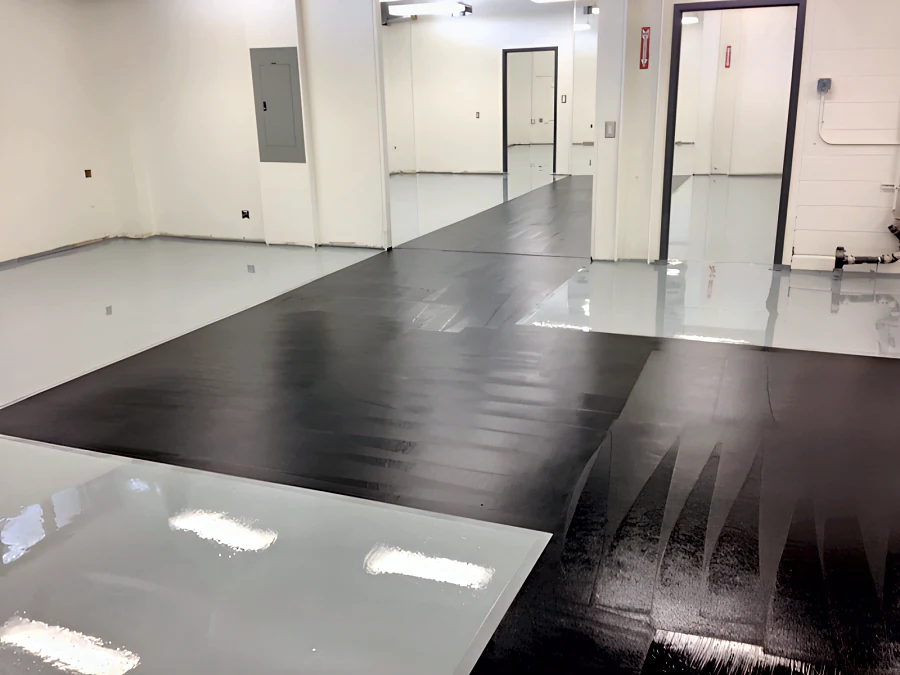
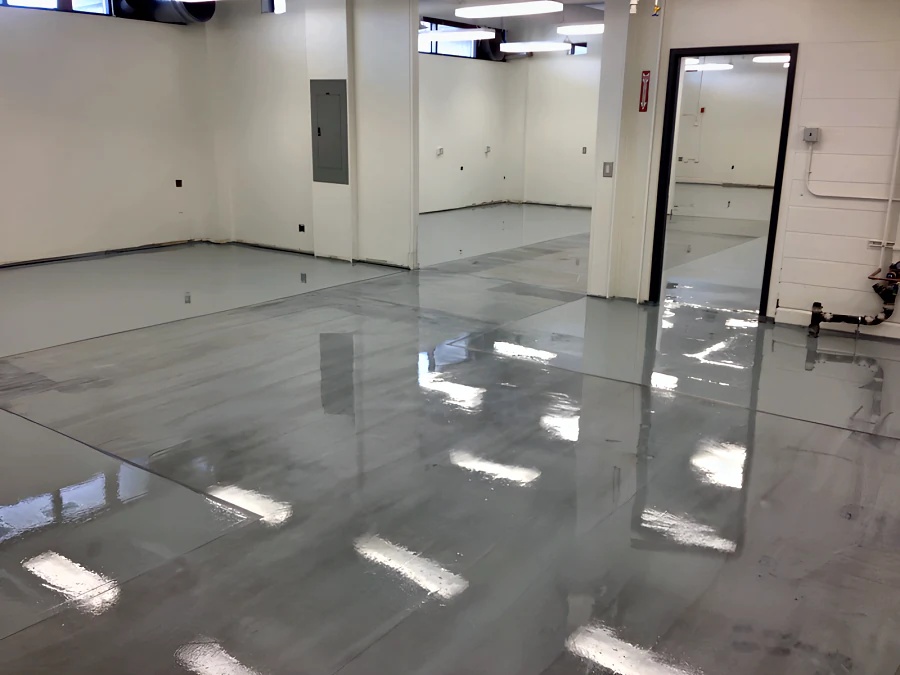
An ESD floor for BC Hydro: the corridor in a black coat while the rooms either side are already finished (left), and the finished high-gloss grey floor running through the rooms (right). More on the projects page.
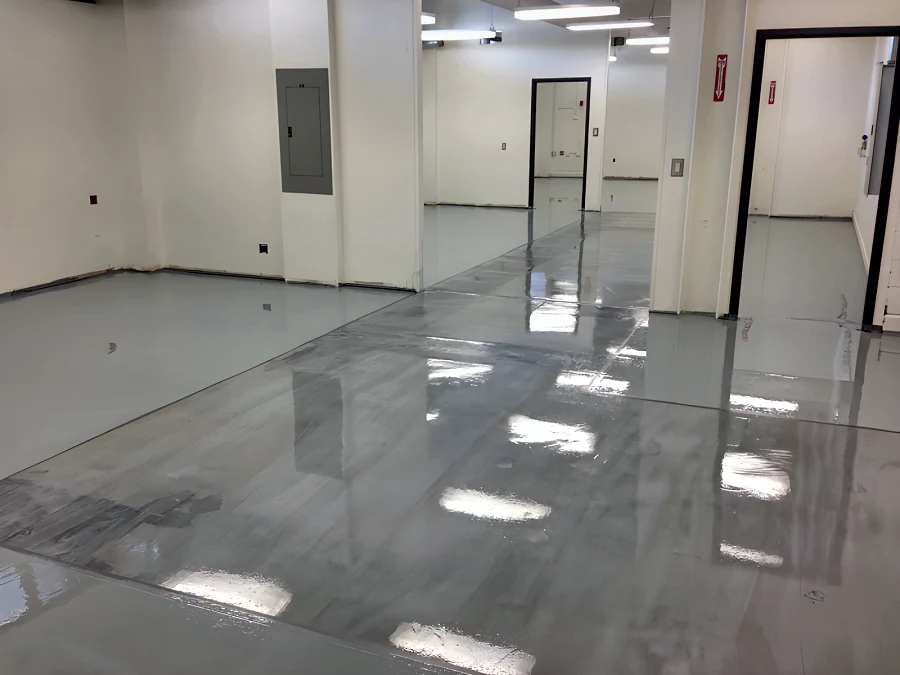
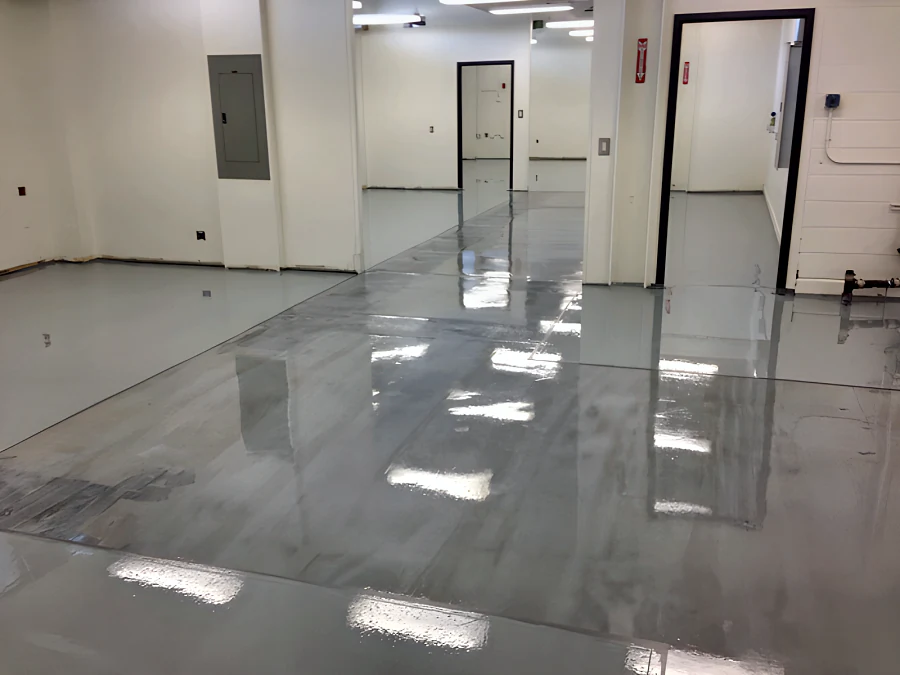
BC Hydro: the finished ESD floor in high gloss through the rooms and doorways (left), and down the corridor (right).
Questions we get asked
Static control FAQs
What is the difference between static-dissipative and conductive flooring?
Both drain charge to ground; they differ in how fast. Conductive floors sit in a lower resistance band and bleed charge quickly, which suits ordnance, some battery work and areas where charge must not linger. Dissipative floors sit in a higher band and drain more gradually, which is usually preferred where people work, because a slower path to ground is gentler if someone contacts a live circuit. Which band your facility needs is set by your ESD control programme, not by the flooring contractor.
Does the coating alone make a floor ESD compliant?
No, and this is the most common misunderstanding on these projects. A static control floor is a system: a conductive network installed under the coating, physical connections to building ground, the coating itself, and a documented test result. A dissipative topcoat installed with no grounding grid is decorative. The floor is also only one element of an ESD control programme that includes footwear, wrist straps, workstations and periodic verification.
How is the finished floor verified?
By measurement, on a grid across the installed area, using the test methods referenced by the governing standard — resistance to ground and point-to-point resistance, recorded at stated temperature and humidity because both affect the reading. The result belongs in your facility file. Any contractor who hands over an ESD floor without measured, documented readings has not finished the job.
Can an existing floor be converted to static control?
Often, but it is not a recoat. The existing surface has to be mechanically prepared and assessed for moisture and bond, the grounding network has to be installed and connected, and the build has to be continuous — a static control floor with an isolated patch of old coating in the middle of it is a floor with a hole in its performance. Whether conversion or replacement is the better value comes out of the assessment.
Site assessments
Send us the slab. We'll tell you what it actually needs.
Photographs and a rough area are enough to start. We'll come out, test moisture, and scope it properly.
Main (604) 968-2040 · Second (604) 230-0256 · estimating@westpacificcoatings.com