Insights — 6 September 2026
Traffic membrane vs epoxy on a suspended slab
There is one specification error in this trade that costs building owners more than every other mistake combined, and it usually starts with a sentence that sounds like prudence: the epoxy quote was cheaper. On a suspended parkade slab, choosing a rigid epoxy floor coating over an elastomeric traffic membrane does not save money. It defers a much larger bill — concrete repair, reinforcing steel corrosion, leak damage to whatever sits below — and hands it to whoever owns the building a few years later.
This article explains why the two products are not interchangeable, why the difference only matters on some slabs, and how the error keeps happening on tenders across BC. If you sit on a strata council or manage a commercial building with parking above other space, the twenty minutes this takes to read is disproportionately well spent.
The one question
What is underneath the concrete you park on?
Every parkade coating decision starts with a single structural question, and most bad specifications never asked it. A slab-on-grade sits on soil. It is continuously supported, it barely deflects under load, and if water gets through it, the water goes into the ground it came from. A suspended slab is a different object entirely: it spans between columns and walls, with another parking level, storage lockers, an electrical room or some other occupied space directly below it.
A suspended slab moves. It deflects under the weight of every vehicle that crosses it, and it expands and contracts with temperature through every day and every season. Reinforced concrete is designed on the assumption that it will crack — the reinforcing steel is there to carry the tension and hold the cracked sections together. Cracks in a suspended parkade slab are not a defect; they are the design working as intended.
Which is exactly why waterproofing, not abrasion resistance, is the governing requirement. Water on a parkade slab is never just water. Every vehicle that enters between November and March carries road salt in on its tyres and drops it in the drip zone as the slush melts. Chloride-laden water finding a crack in a suspended slab has a direct route to the reinforcing steel, and corroding steel expands, spalling the concrete around it. That is how a coating decision becomes a structural repair project.
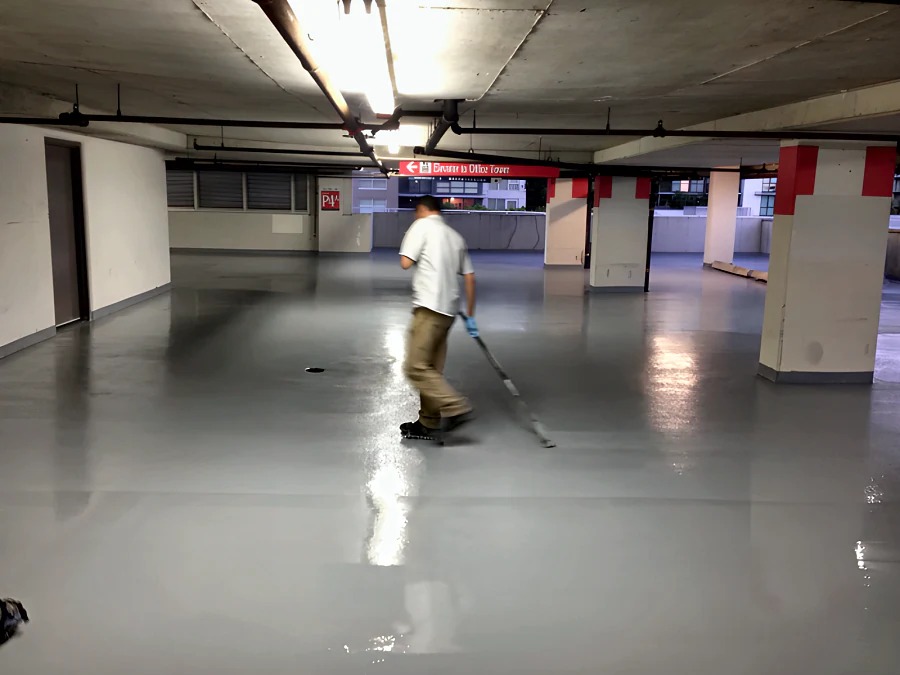
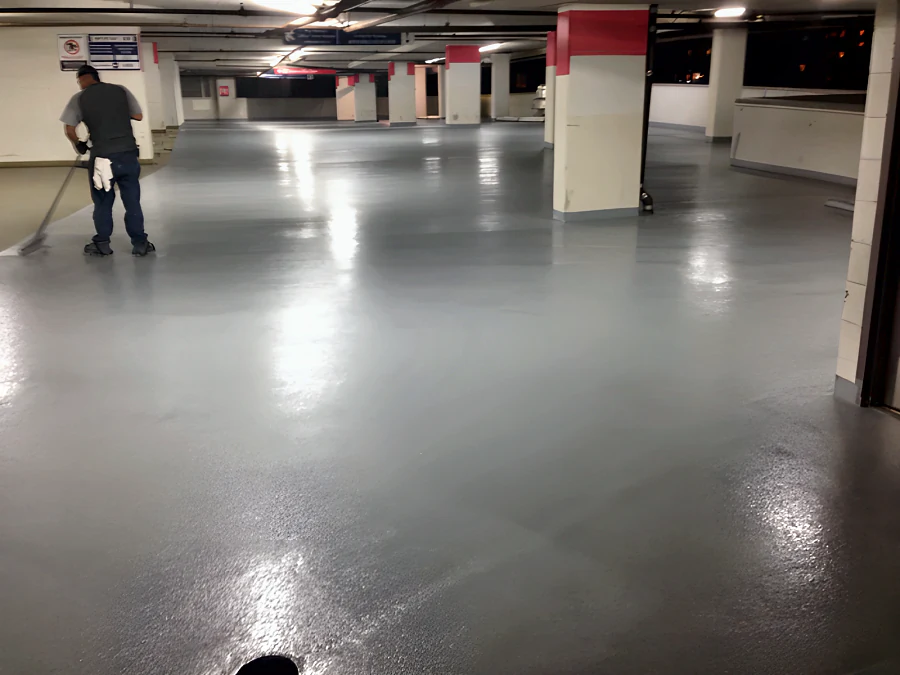
A parkade traffic coating going down at Three West Centre in Richmond, 2013: spread by squeegee across a parking level (left), and the drive aisle and stalls freshly coated (right). More of this work on our Richmond page.
Two different jobs
Why rigidity is the whole problem
Epoxy floor coatings are excellent at what they are actually for. Cured epoxy is hard, chemically resistant and wears well under traffic, which is why it earns its place on warehouse and industrial floors across the Lower Mainland. But that hardness is the point of failure on a moving slab: a cured rigid coating has effectively no ability to stretch across a crack that opens beneath it. When the slab cracks — and a suspended slab will — the coating cracks with it, along the same line, to the same width.
The insidious part is what the failure looks like, which is almost nothing. A hairline crack in a grey coating on a grey slab is invisible from standing height. The coating on either side of the crack is still bonded, still glossy, still passing every casual inspection. Meanwhile the crack is doing what cracks do: admitting every wash of salt water that crosses it, wetting the steel, season after season. By the time rust staining or spalled concrete announces the problem, the corrosion has been running for years and the repair has moved from a coating line item to a structural one — drip trays over parked cars below, sounding surveys, concrete removal around corroding bars.
A traffic membrane — more formally an elastomeric, typically polyurethane, vehicular traffic coating — is engineered around the opposite priority. It stays flexible after cure so it can bridge the hairline cracks that open and close beneath it, and it is installed as a waterproofing system: a primer, an elastomeric base coat that does the waterproofing, and one or more wear coats loaded with aggregate to take the traffic. Details are hand-worked at cracks, joints, drains, and upstands before the field coats go down. The systems we install come from the manufacturers whose names appear on parkade specifications across the province — Tremco's Vulkem line, BASF's MasterSeal Traffic systems, and Sika — selected against the deck, the exposure, and the traffic pattern rather than by habit.
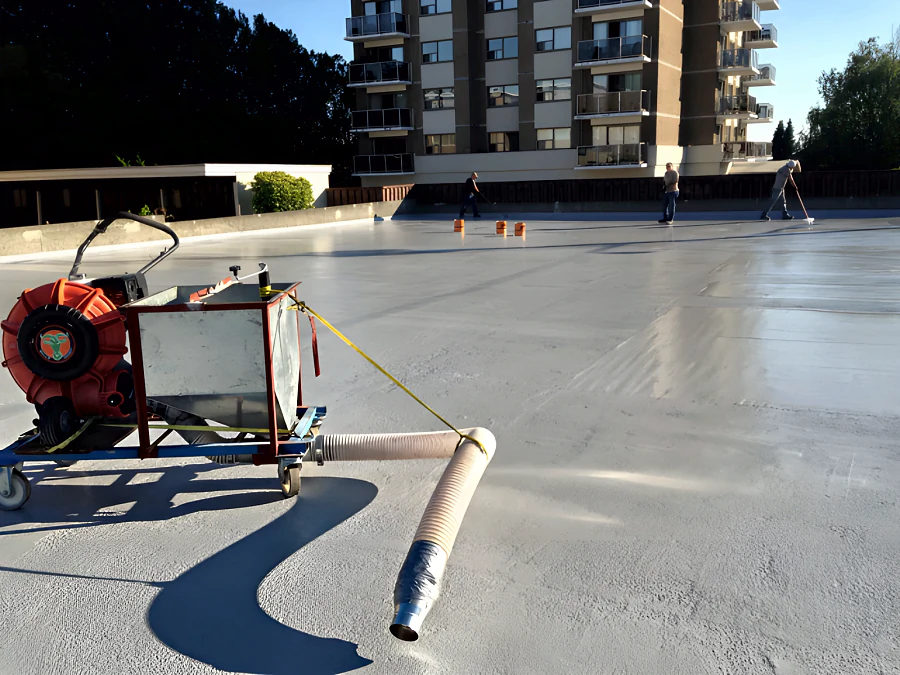
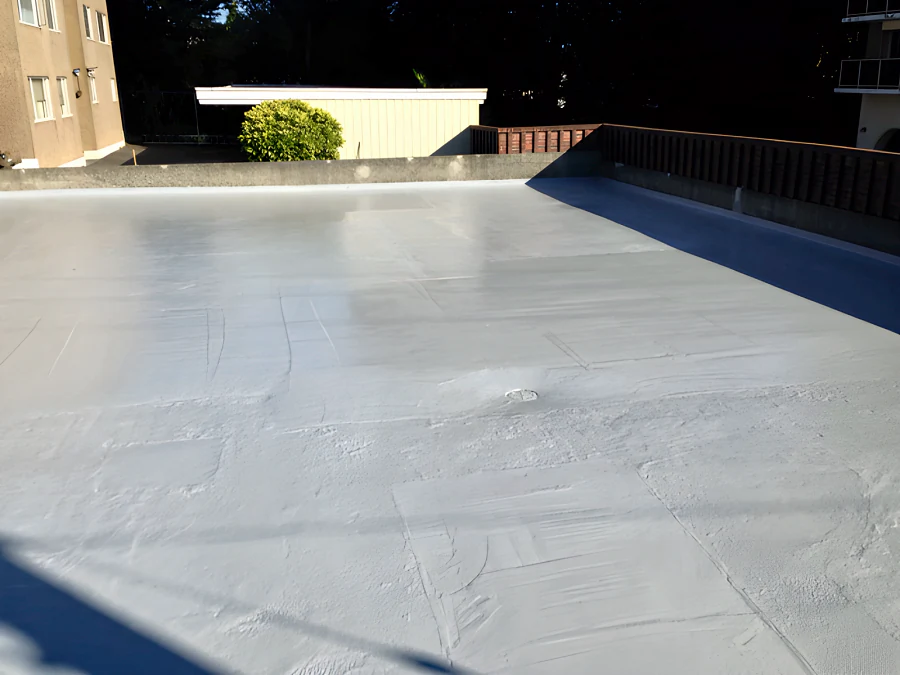
A flexible polyurethane traffic membrane, MasterSeal Traffic 1500 (formerly Sonoguard), going down on an exposed parkade deck in New Westminster in 2012: the blower-fed hopper for broadcasting aggregate, with the crew working the coat beyond (left), and the membrane carried across the deck, round the drain and up the parapet (right). More on our New Westminster page.
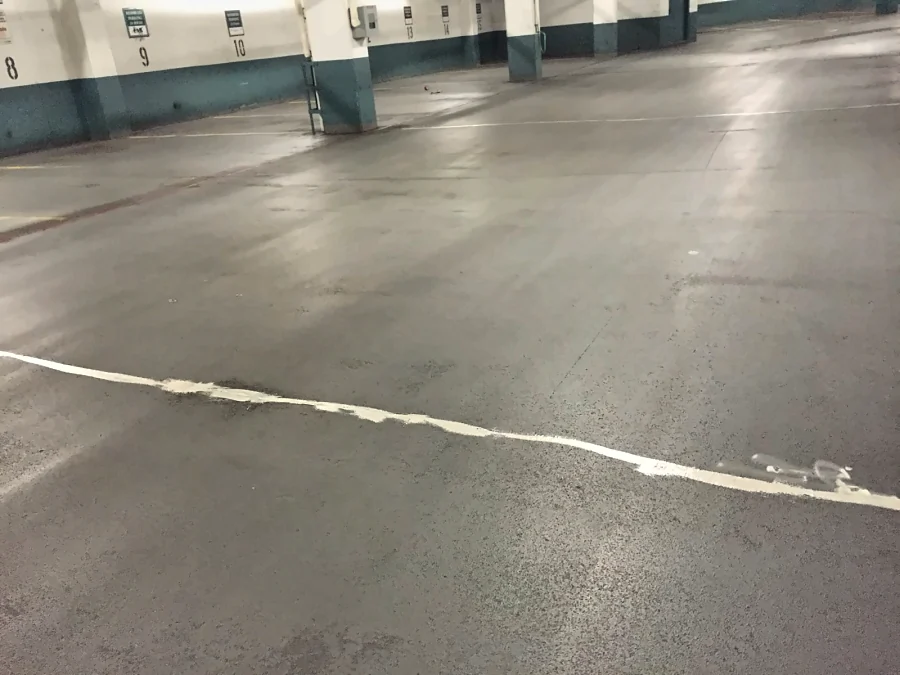
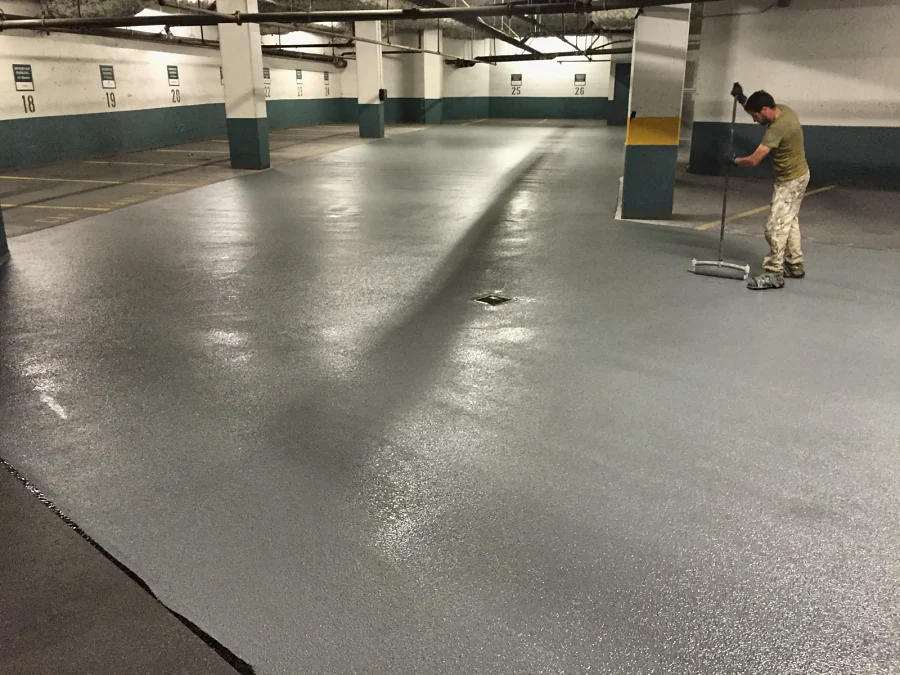
A Downtown Vancouver parkade, 2015: a crack filled across the drive aisle before coating (left), and the traffic coating going down the aisle (right). More of our work on the Vancouver page.
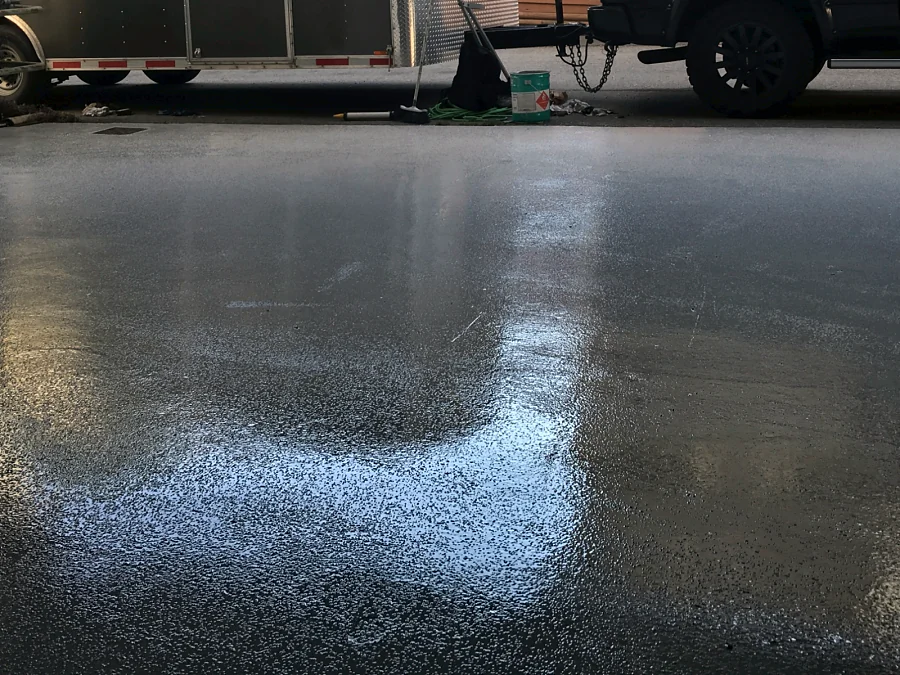
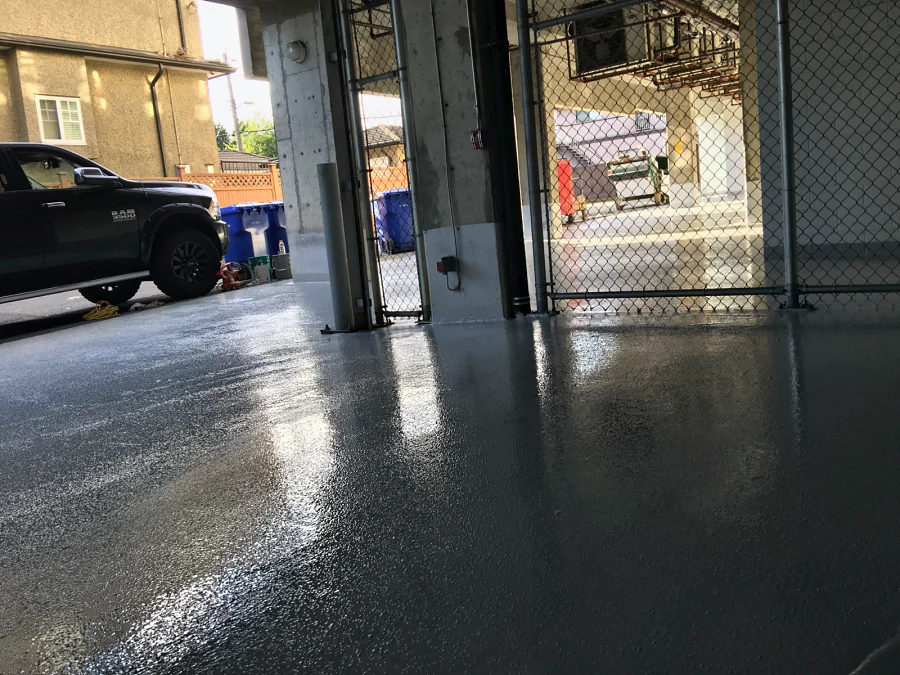
Tremco Vulkem 350NF/346 on a loading bay and garbage area in Vancouver: the fresh coat at the mouth of the bay (left), and laid round the column and the posts of the garbage enclosure (right). More on the projects page.
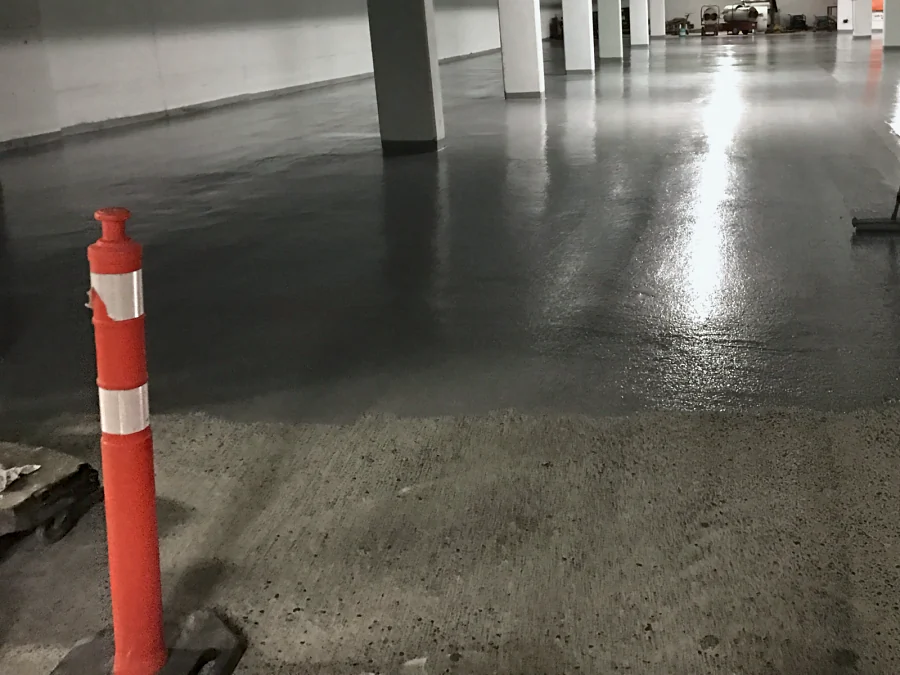
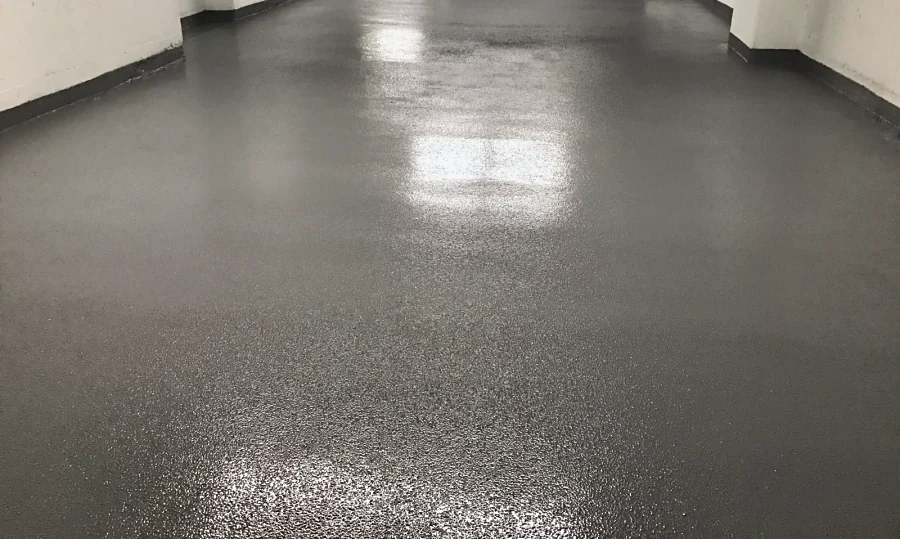
Tremco Vulkem 350NF/950NF/950NF through a 30,000 square foot parkade in Vancouver for Lark Group: the coat squeegeed across a parking level past the columns, the shot-blasted slab still bare in front (left), and a finished drive aisle (right). More on the projects page.
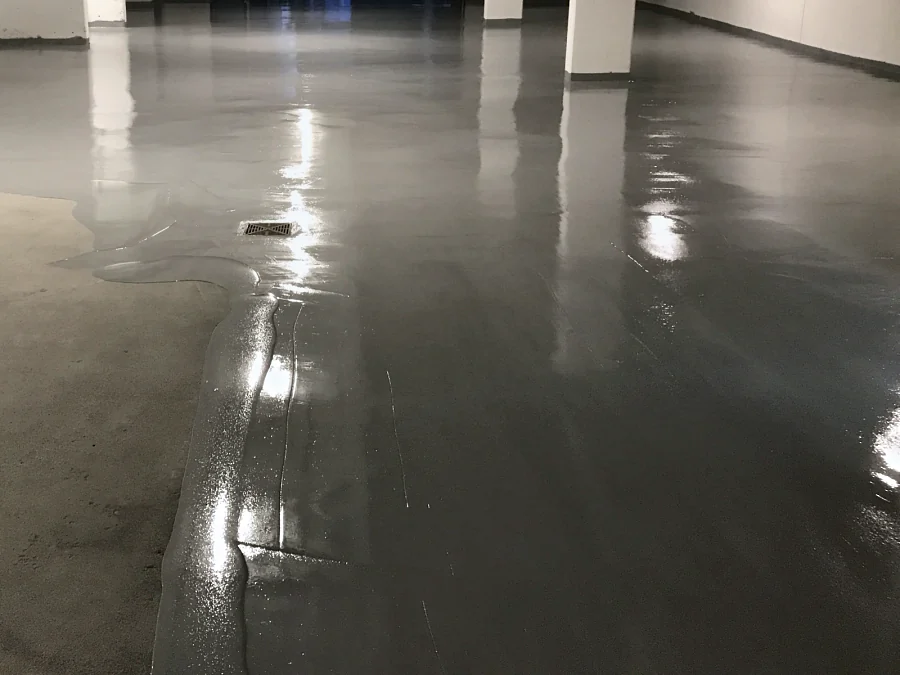
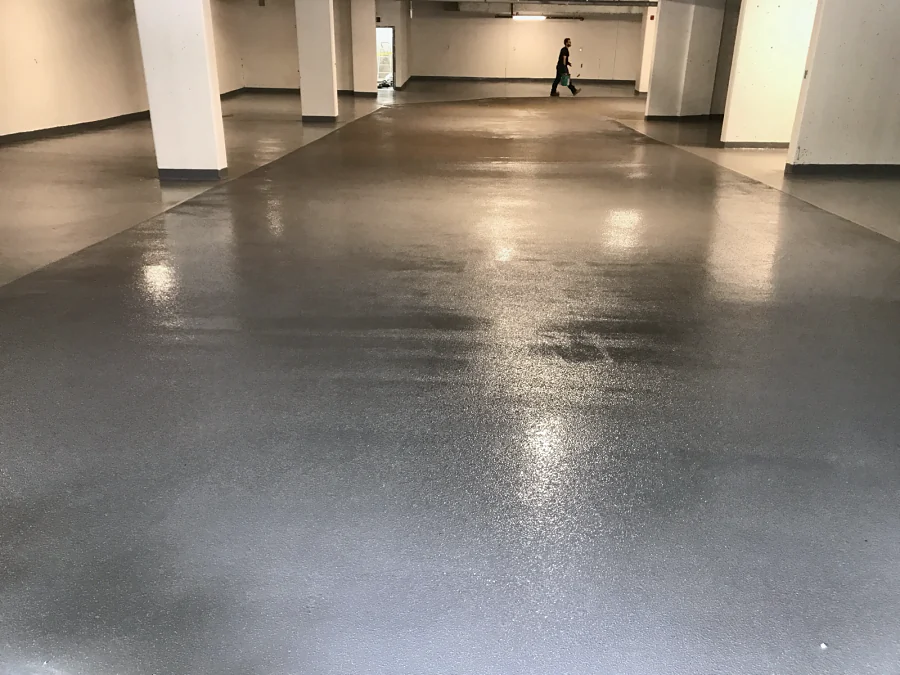
The same Tremco Vulkem 350NF/950NF/950NF system in a residential parkade in North Vancouver for Milori Homes, 2017: the grey coat flowing out over the bare slab and round the floor drain (left), and the textured coat down the drive aisle (right). More on the projects page.
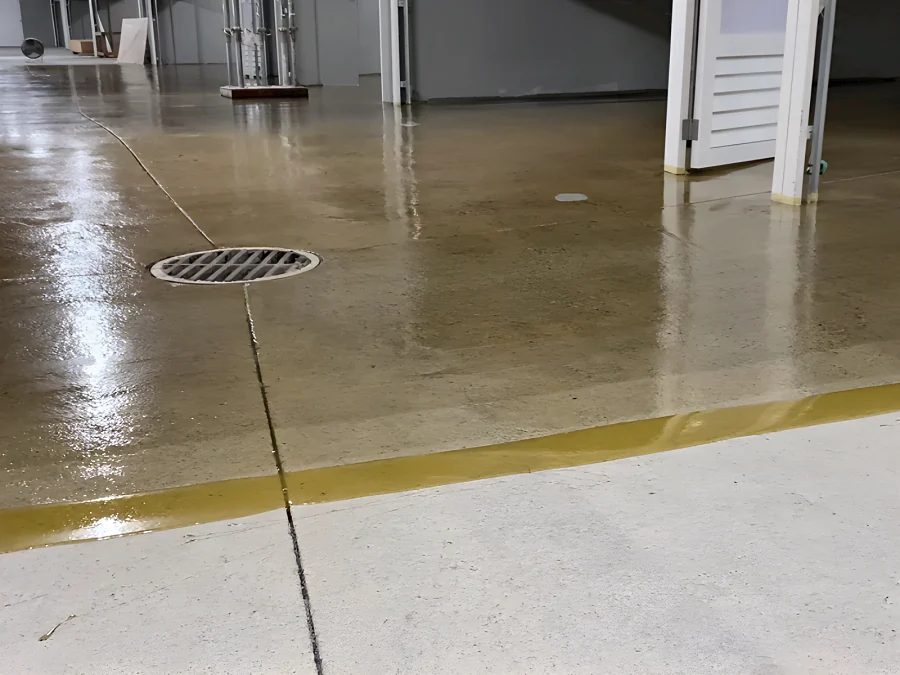
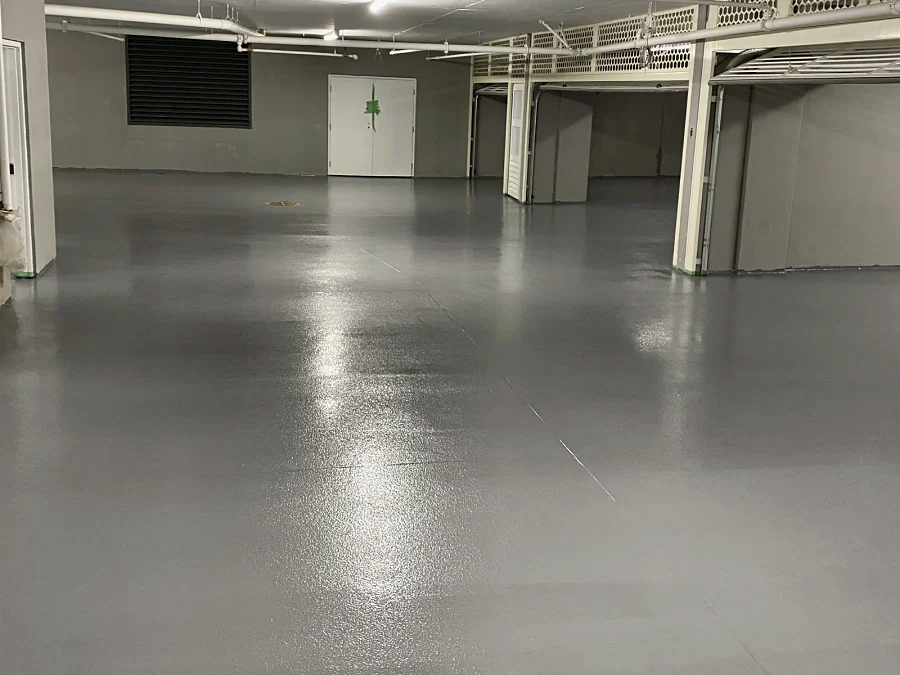
A Tremco traffic coating through the 68,000 square foot parkade at 2289 Bellevue Avenue, West Vancouver, for Cressey Development Group in 2020: the first coat going across the bare concrete past a floor drain (left), and a finished level to the double doors (right). More on the projects page.
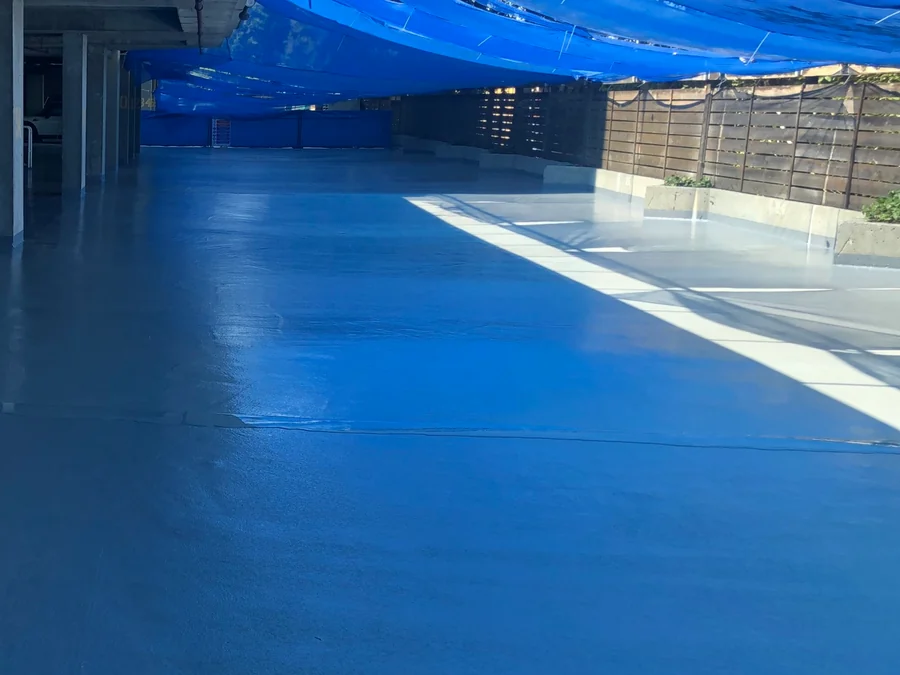
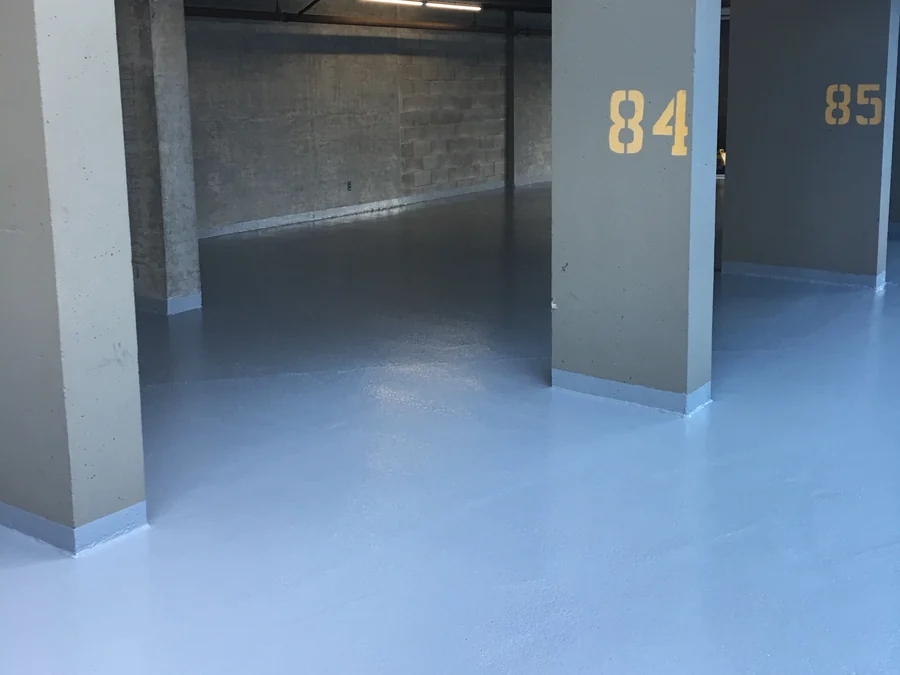
The same Tremco family again, Vulkem 350NF/950NF/951NF, through a residential tower’s parkade in New Westminster for PMC Construction: the coat across the half-open deck, tarped while it cured (left), and turned up the columns as a coved base (right). More on the projects page.
Side by side
The comparison that should be on every tender
Set the two systems against each other on the criteria that actually decide the outcome, and the pattern is hard to miss: they are answers to two different questions.
| Criterion | Traffic membrane | Rigid epoxy coating |
|---|---|---|
| Movement and cracks | Remains elastomeric after cure; bridges hairline cracks that open and close under load and temperature | Rigid after cure; cracks mirror through the coating along the same line |
| What it protects | The reinforcing steel in the slab and the space below it — it is a waterproofing system first | The concrete surface from abrasion and chemicals — it is a floor finish, not waterproofing |
| Where it belongs | Suspended slabs and ramps exposed to vehicles, water and de-icing salt | Slabs-on-grade and dry interior floors where waterproofing is not the requirement |
| How it is built | Primer, elastomeric base coat, aggregate-loaded wear coats; extra wear coats on ramps and turn lanes; detailing at cracks, joints and drains | Primer and body coats, sometimes with broadcast aggregate; minimal detailing |
| Failure mode when misapplied | On grade it is rarely wrong, only sometimes more than the slab needed | On a suspended slab: invisible cracked waterproofing, chloride at the steel, corrosion, spalling, leaks below |
Build-ups, coverage rates and crack-bridging capability vary by manufacturer and by system — the datasheet of the specific product proposed is the document that governs, not this table.
Most multi-level parkades need both answers at once. The upper levels are suspended and need membrane; the bottom level sits on grade, where an epoxy or other rigid system is often the correct and more economical choice. A specification that names one product for the whole structure has usually got at least one level wrong — in one direction it wastes money, in the other it quietly builds a corrosion problem.
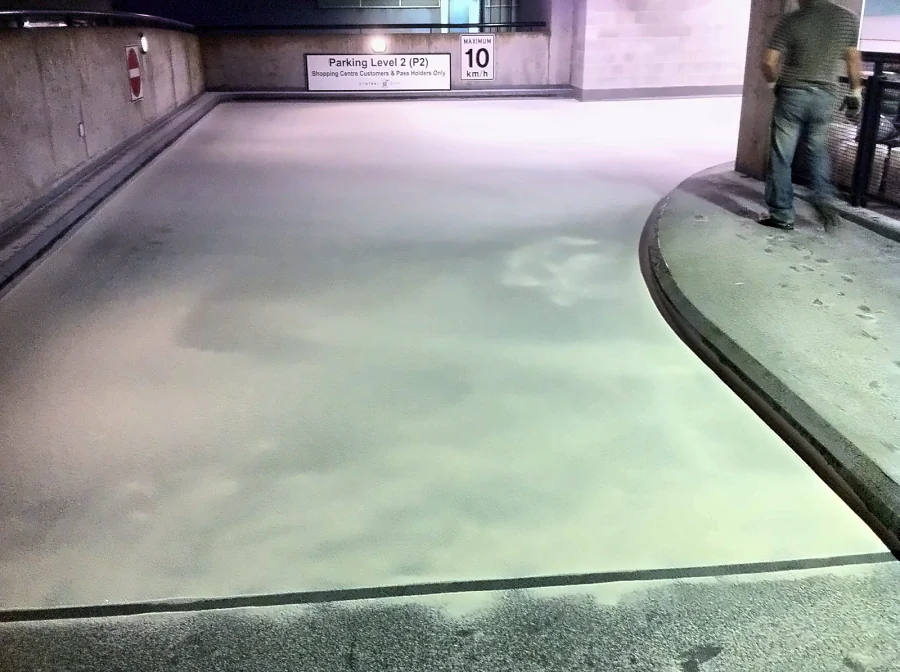
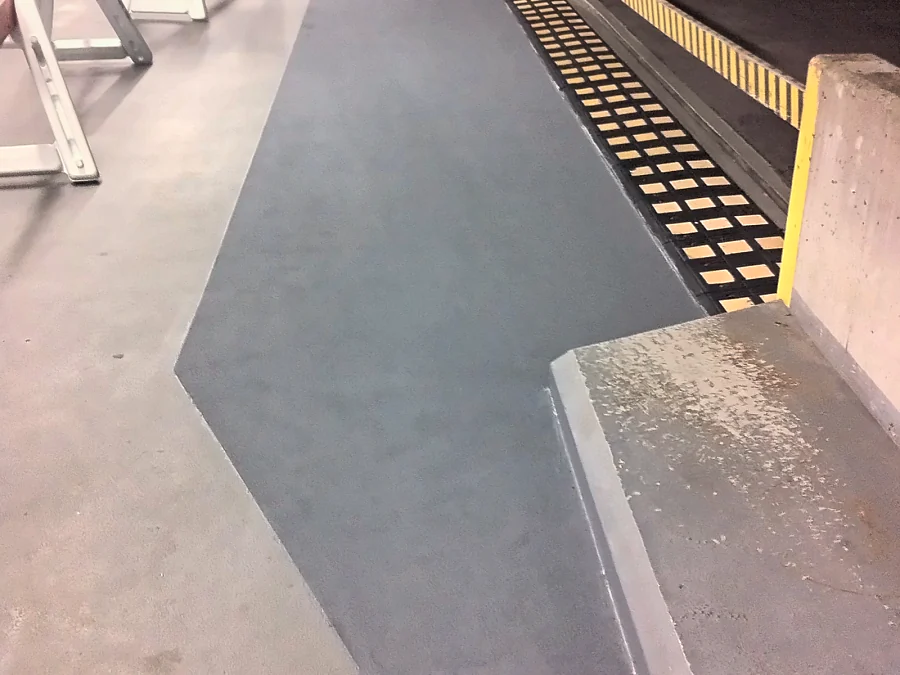
Ramps and edges get the extra work. The Central City Shopping Centre parkade in Surrey, 2011: aggregate broadcast into the coat on the ramp down from Parking Level 2 (left), and the coating detailed along the parapet edge and up the face of the curb (right). More of our work on the Surrey page.
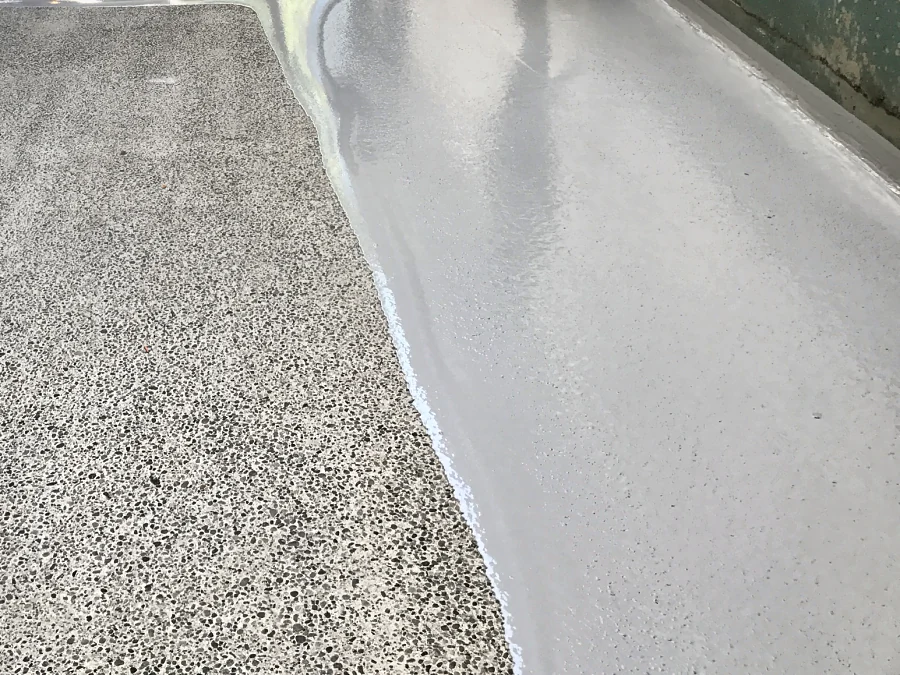
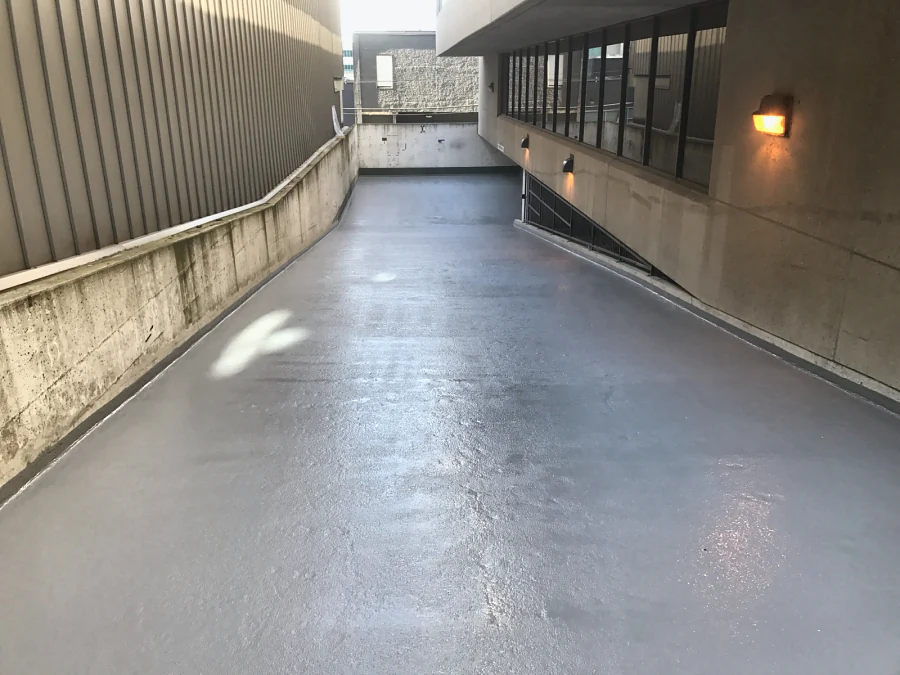
Another entrance ramp, at the Vancity parkade in Vancouver for SBW, 2017: the new coat’s edge over the bare concrete at the foot of the ramp (left), and the ramp finished (right). More on the projects page.
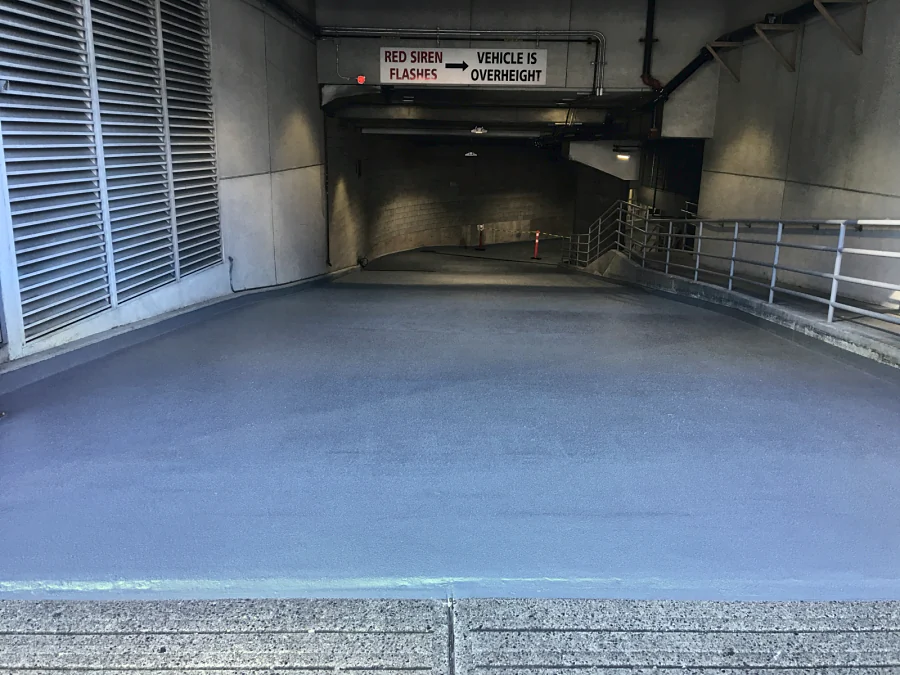
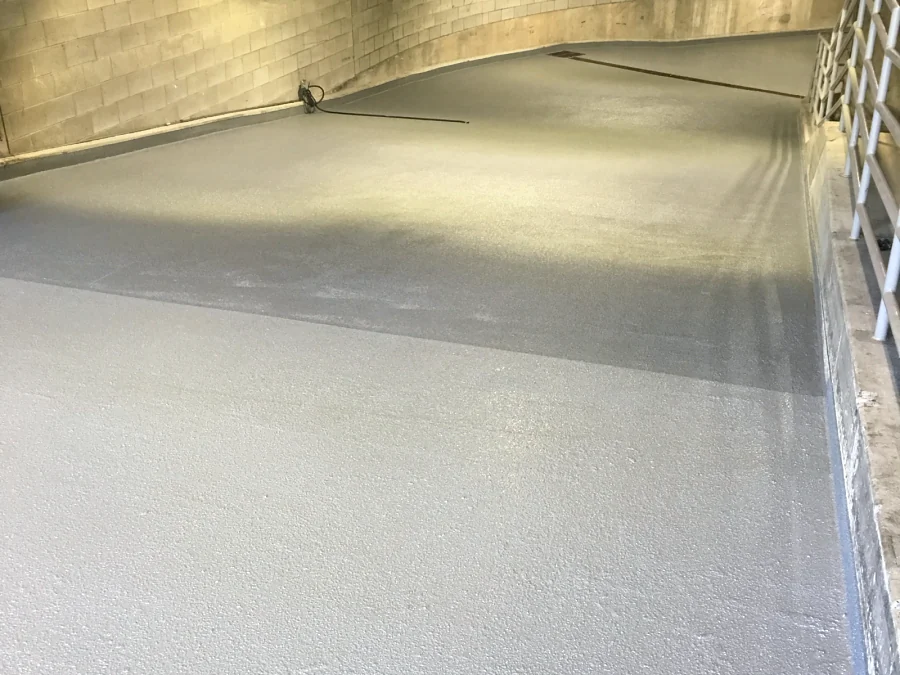
A commercial building’s parkade in Downtown Vancouver, 2016: the entrance ramp coated (left), and the coat going down on the curve of the ramp below, darker where it is still wet (right). More on the projects page.
How it keeps happening
Anatomy of the error, tender by tender
Nobody chooses this failure on purpose. It arrives through the paperwork. A tender goes out asking for a price on "parkade floor coating" without naming the slab type. One bidder prices the membrane the suspended levels need; another prices an epoxy broadcast system, which comes in meaningfully cheaper per square foot because it is doing a smaller job. On paper the two numbers sit in the same column of a comparison spreadsheet as though they describe the same work. The lower number wins, and the error is now cast in place for a decade.
The moment it goes wrong is almost never the installation. The epoxy goes down cleanly, looks sharp at handover, and photographs well. The moment it goes wrong was earlier, in the sentence the tender never contained: what is under this slab, and what happens to the space below when water gets through? Any bid comparison that does not answer that question first is comparing prices on two different products, one of which cannot do the job.
This is also where climate stops being background. A parkade in the Lower Mainland sees salt every winter; on the Sea-to-Sky the exposure is harsher again, with hard freezes right through the winter. The wetter and saltier the service, the faster a cracked rigid coating converts into a corrosion problem, and the stronger the case for a membrane detailed to the deck it is on.
If you are planning parkade work, the sequence matters: identify each slab's type first, then match the system to the slab, then compare prices on like-for-like scope. That is the assessment we run before we quote — it is why our pricing is assessed rather than blind per-square-foot — and it is laid out alongside the systems themselves in our coating systems library and our guide to parkade waterproofing. Strata councils working from a depreciation report will find the connection between that document and coating scope in what your depreciation report says about your parkade.
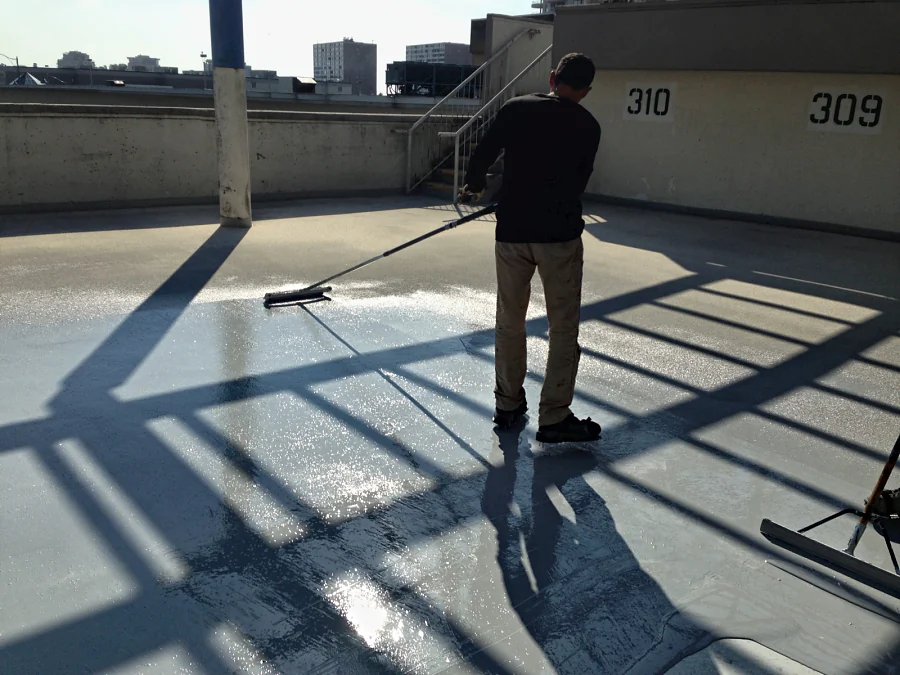
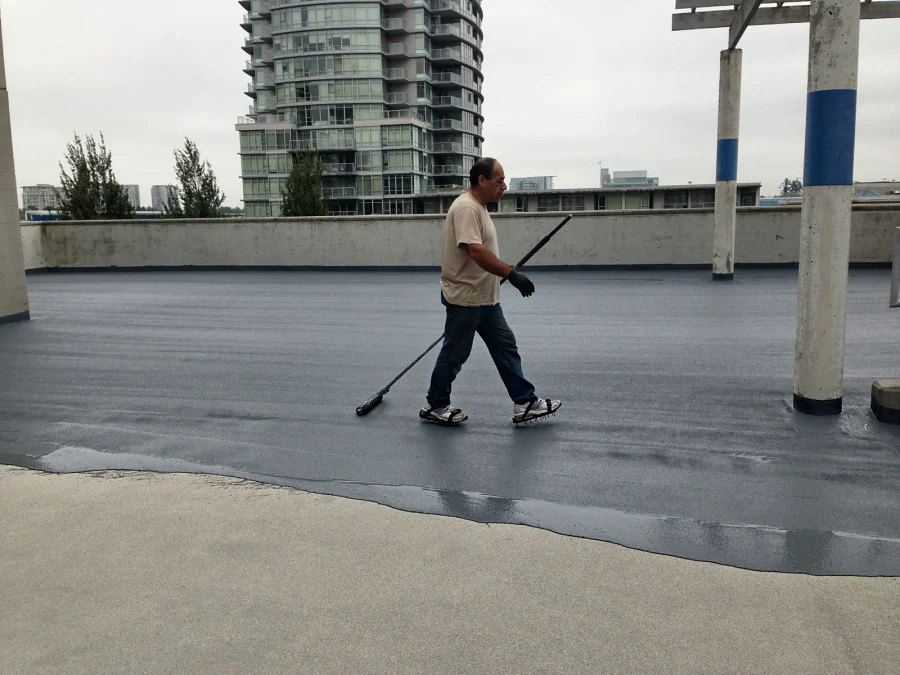
A roof deck takes the weather directly. The open top level of the Three West Centre parkade in Richmond, 2013: the grey coat spread by squeegee across the deck (left), and a darker textured coat rolled out over it (right). More of our work on the Richmond page.
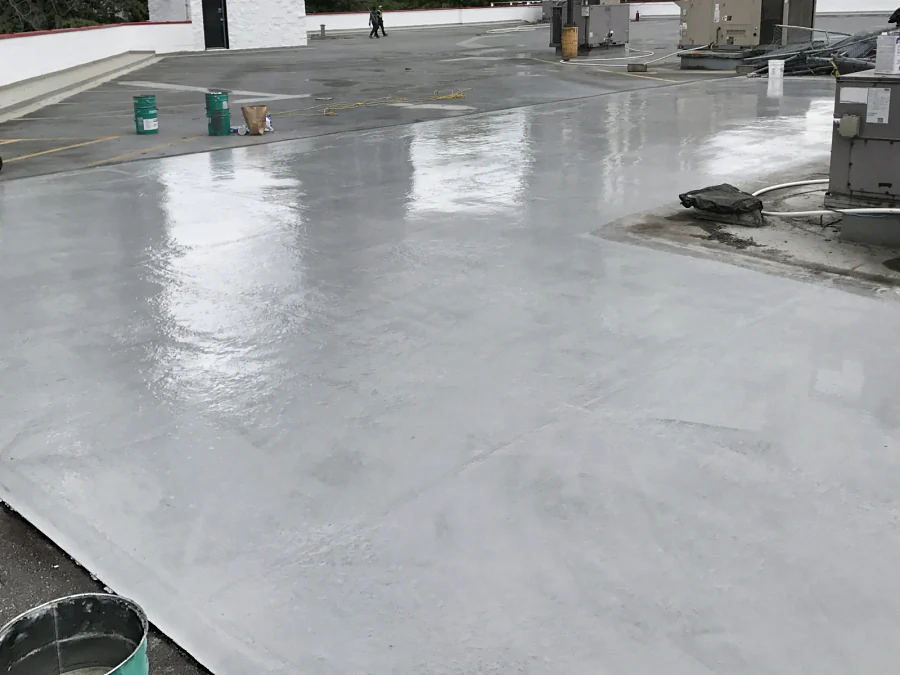
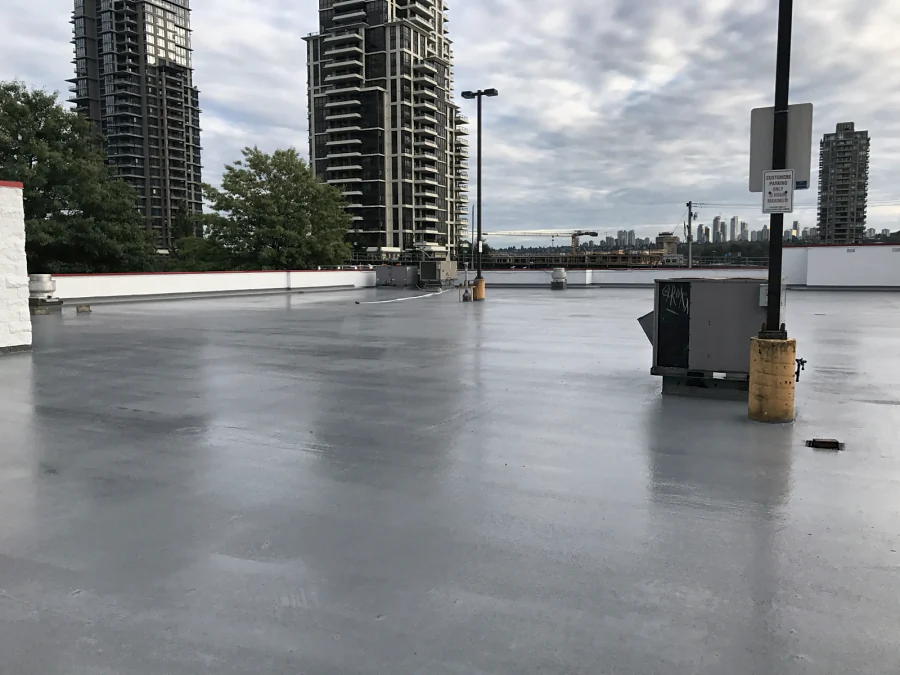
Another roof exposed to the weather: the rooftop customer parkade of a Staples store in Burnaby, 2017, in the Tremco Vulkem 350NF/950NF/951NF system, the fresh coat by the rooftop units (left), and the finished deck (right). More on the projects page.
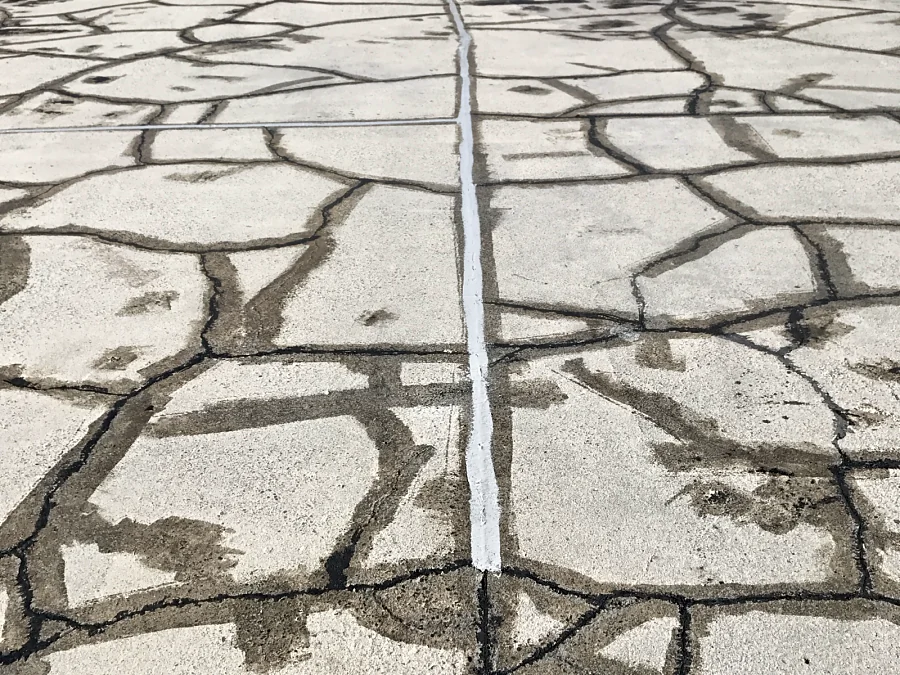
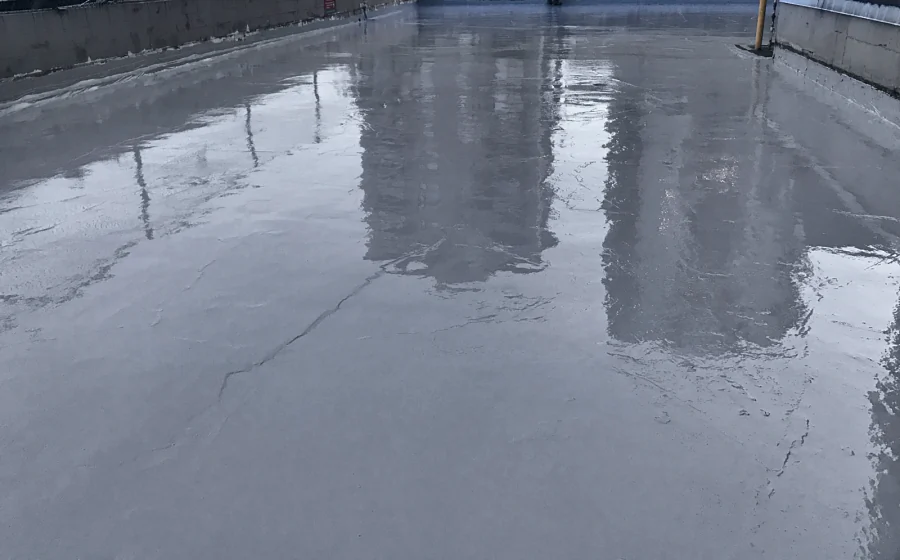
Another exposed deck, a hotel’s exterior parkade deck in the West End, Vancouver: the dense network of cracks repaired (left), then Tremco Vulkem 360NF/346 laid over them (right). More on the projects page.
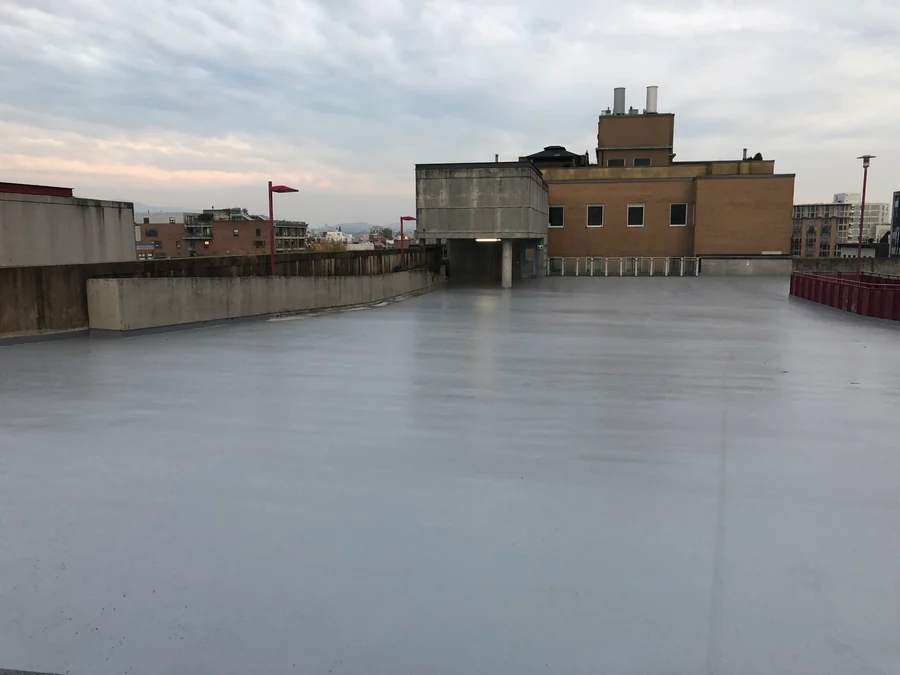
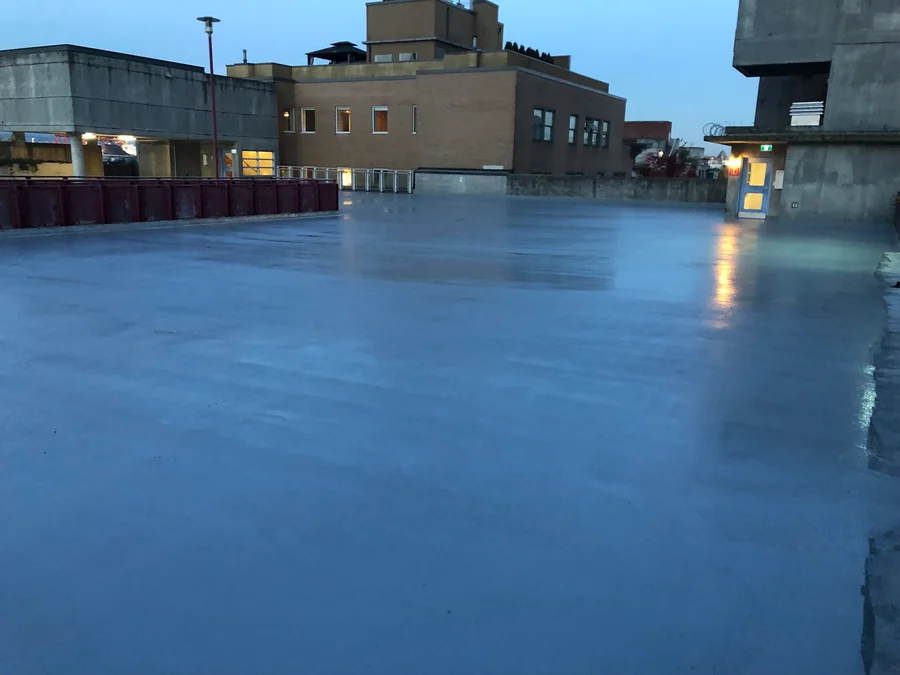
A roof deck recoated rather than patched: the 50,000 square foot top deck of the Gastown parkade in Vancouver, its old coating removed and the deck relaid in Tremco Vulkem 350NF/950NF/951NF for Heatherbrae Builders, grey and even to the stair tower (left) and at dusk (right). More on the projects page.
Questions we get asked
Membrane vs epoxy FAQs
Can epoxy ever be used on a suspended slab?
Yes — where the slab is genuinely protected from water and de-icing salt, such as an interior mezzanine or an upper production floor in a dry building, a rigid coating can be the right choice. What disqualifies epoxy is not the slab itself but the exposure: a parkade slab collects vehicle-borne water and chloride all winter, and once waterproofing is part of the job, movement capability stops being optional.
Why does a traffic membrane cost more than an epoxy coating?
Because it is a multi-coat waterproofing system, not a floor finish. A traffic membrane is built up from a primer, an elastomeric waterproofing base coat and one or more aggregate-loaded wear coats, with hand detailing at every crack, joint, drain and upstand. That labour and material is what makes it able to do a job epoxy cannot. The honest comparison is not membrane against epoxy — it is membrane against the concrete repair and water damage the epoxy would have allowed.
How do I know whether my parkade slab is suspended?
Ask what is directly underneath the concrete you park on. If the answer is another parking level, storage lockers, an electrical room or any other occupied space, the slab is suspended. If the answer is soil, it is a slab-on-grade. Most multi-level parkades contain both — suspended slabs on the upper levels and a slab-on-grade at the bottom — and the structural drawings or the building's depreciation report will confirm which is which.
My suspended slab already has epoxy on it — what should we do?
It is not automatically an emergency, but it deserves a proper condition assessment rather than a repaint. That means mapping the cracks, checking for delamination and finding out whether water and chloride have been reaching the reinforcing steel. Depending on what the assessment finds, the answer ranges from monitoring, to localised repair, to removing the coating and installing the membrane the slab needed in the first place. The earlier that question is asked, the cheaper every answer is.
Keep reading
Related reading
How traffic membrane systems are assessed, detailed and installed on working parkades.
Why parkade membranes fail earlySix reasons a membrane fails years before it should — and what each one costs.
Structural concrete repairWhat it takes to fix the corrosion and spalling a failed coating decision leaves behind.
Site assessments
Send us the slab. We'll tell you what it actually needs.
Photographs and a rough area are enough to start. We'll come out, test moisture, and scope it properly.
Main (604) 968-2040
Second (604) 230-0256
estimating@westpacificcoatings.com