Delta · Since 2001
Epoxy and industrial floor coatings in Delta.
Agricultural, industrial and port-adjacent floor area on delta soils — high groundwater and heavy vehicle loading in combination.
Delta
Groundwater and heavy loading together
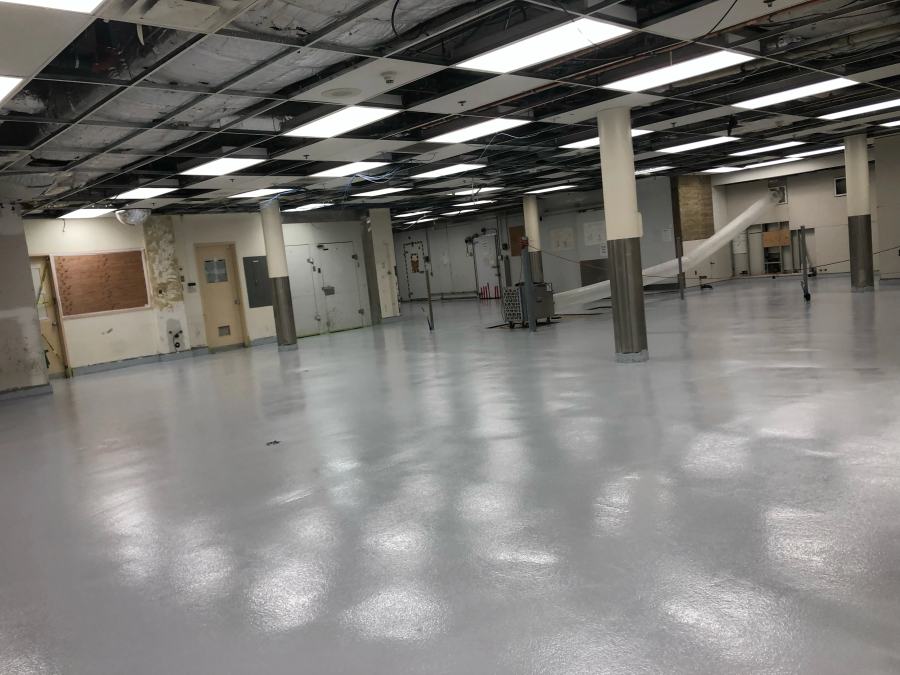
Delta combines the two hardest conditions for a floor coating: shallow groundwater in delta soils, which drives vapour up through slabs on grade continuously, and genuinely heavy loading from agricultural equipment, port-adjacent warehousing and truck traffic.
That combination rules out thin systems. A coating here needs both vapour tolerance and real film thickness, and it needs to be installed over a slab whose moisture content has been measured rather than estimated. This is the specification conversation we have most often in Ladner and Tsawwassen.
Food and agricultural facilities add a third requirement — a finish that survives frequent washdown and sanitation chemistry, with slip resistance set high enough to be safe wet while still being cleanable.
- Design conditions
- Vapour drive plus heavy load
- Sectors
- Agricultural · Port · Food
- Also serving
- Ladner · Tsawwassen
Services
What we install in Delta
Parkade waterproofing
Traffic-bearing membranes for Delta parkades, ramps and roof decks.
Learn more →Ground conditions
On the delta, the water table decides the system
Delta sits on the Fraser delta, and the ground reflects it. Ladner, the Tsawwassen flats and the Tilbury industrial lands are built on soft alluvial and peat deposits with a water table that sits close to the surface for much of the year. That has two consequences for anything laid on a slab here, and both of them are routinely missed at quoting stage.
The first is moisture. A slab-on-grade over a high water table carries a vapour drive that a comparable slab on the North Shore simply does not, and it can read perfectly dry to the hand while still pushing enough moisture to break the bond of a coating installed over it. This is the single most common reason a coating fails in this part of the Lower Mainland, and it is entirely preventable: an in-situ relative humidity test gives a number, a taped-down plastic sheet gives an opinion. Where the reading comes back high the answer is a moisture-tolerant build-up or a mitigating primer — not another coat of the same product.
The second is movement. Differential settlement is common enough on delta soils that joints and cracks in an older slab should be treated as live rather than static. A rigid filler across a joint that is still moving will telegraph through the finish within a season, which is why joints get a movement-capable treatment here more often than they would on firmer ground further east.
The industrial stock
Tilbury, Annacis Island and the port corridor
Delta's industrial floor area is concentrated in a few places — the Tilbury lands, Annacis Island, and the warehousing and logistics that has grown up around the Roberts Bank corridor. It is a different mix from the strata parkades that dominate the North Shore, and the systems follow the use rather than the postcode.
Distribution and warehouse floors here take hard-wheeled forklift traffic over long aisle runs, where the failure point is almost always the joints rather than the field of the slab. Food and beverage plants are the opposite case: the field of the floor is under constant attack from hot washdown, cleaning chemicals and thermal shock, and the detailing at coving and falls to drain matters more than the wear coat. Where a plant runs a chilled or frozen area, the installation window itself becomes the constraint, because most resin systems have a minimum substrate temperature below which they will not cure properly — the datasheet governs, and we work to it rather than around it.
Agricultural and processing buildings across Ladner and East Delta add a third pattern again, usually older slabs that have never been coated and need assessment and repair before anything goes down. We would rather tell you the preparation is larger than you hoped than install over a substrate that will not hold it.
Questions
What Delta clients ask us.
We are close to the water in Ladner. Does salt air affect a coating?
It affects the concrete more than the coating. Marine air carries chlorides, and chlorides are what corrode reinforcing steel — the same mechanism as road salt, arriving more slowly and continuously. On waterfront and near-shore Delta structures we look harder at existing concrete condition, because the repair scope is more often the real story than the membrane is.
What do the Tilbury and Annacis industrial floors usually need?
Heavy-duty. Those are working industrial floors taking forklift traffic, point loads and chemical exposure, so they typically want a mortar-filled epoxy or a broadcast system rather than a thin coating that will wear through in a year. Where there is hot wash-down or thermal cycling, urethane mortar earns its higher cost. We specify from what actually hits the floor, not from a catalogue tier.
Can you work around a 24-hour operation?
Yes, though it takes more planning than a business that closes. We section the floor, work the sections your operation can release, and schedule around shift changes and truck movements. On genuinely continuous operations, fast-set systems sometimes justify their extra cost purely because they shorten the window each section is out.
Do you cover Tsawwassen and the ferry terminal area?
Yes, all of Delta including Ladner, Tsawwassen and North Delta, along with the industrial areas on Annacis Island and at Tilbury. Exposed structures out that way take real weather, which is worth factoring into scheduling for anything installed outdoors.
Site assessments
Have a slab in Delta you're worried about?
Photographs and a rough area are enough to start. We'll come out, test moisture, and scope it properly.
Main (236) 873-2580 · Second (604) 230-0256 · estimating@westpacificcoatings.com