Langley · Since 2001
Epoxy and industrial floor coatings in Langley.
City and Township together — the largest concentration of warehouse and distribution floor area south of the Fraser, and the heaviest wheel loads we coat.
Langley
Warehouse floors fail at the wheels, not in the middle
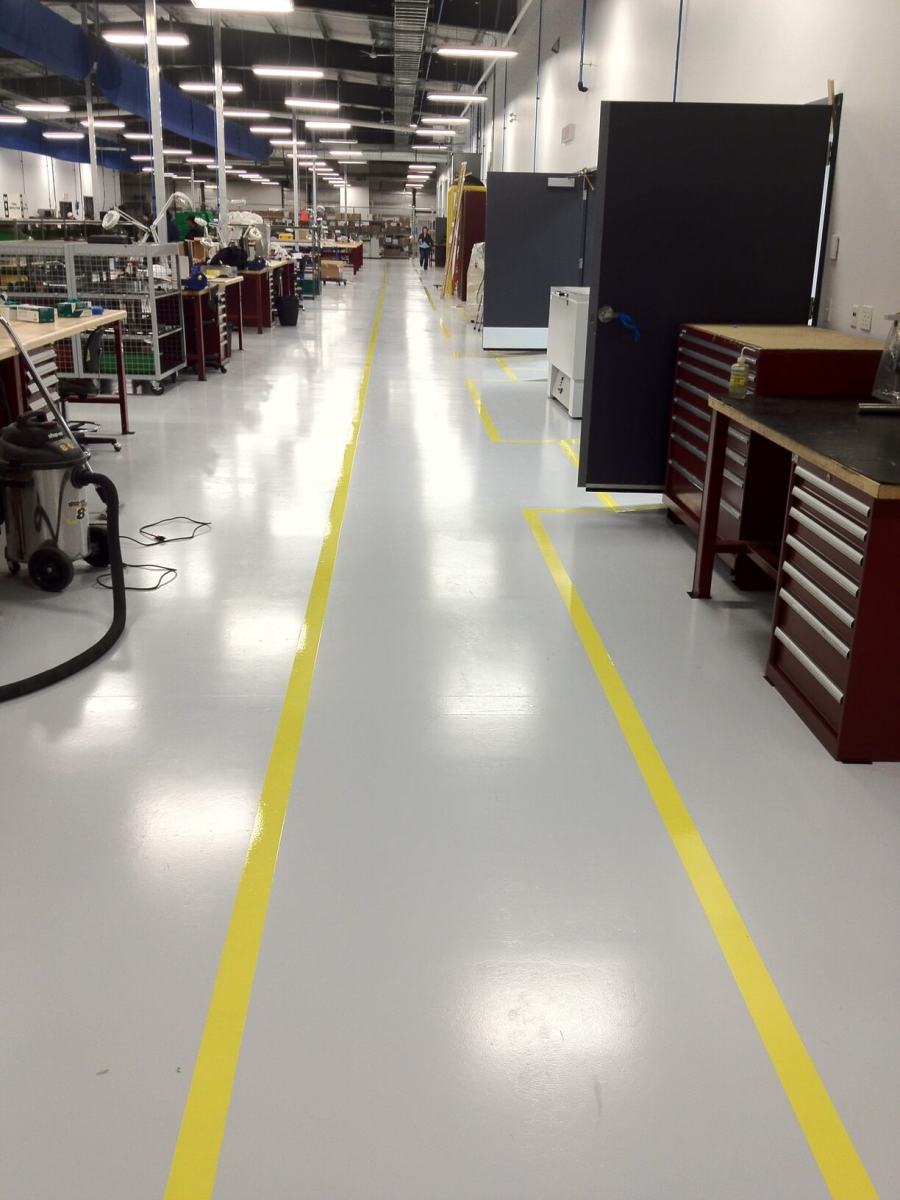
Langley Township holds an enormous amount of distribution and light-industrial floor area, and almost all of the coating failures we are called to look at there follow the same pattern: the middle of the floor is fine and the racking aisles, dock approaches and turning circles are worn through to concrete.
That is a thickness and chemistry problem, not a workmanship problem. A thin-mill coating specified on price will not survive steel-wheeled pallet jacks or a loaded reach truck pivoting in the same spot forty times a day. Those zones need a high-build or mortar system even when the rest of the floor does not, and specifying the floor in zones is usually cheaper than coating the whole thing to the heaviest standard.
Joints are the other Langley pattern. Saw-cut control joints in a warehouse slab take the impact of every hard wheel that crosses them, and once the arris spalls the damage spreads fast. Armoured or filled joints are worth the money in any building with real forklift traffic.
- Sector
- Distribution and warehousing
- Failure zone
- Aisles, docks, turning circles
- Approach
- Zoned specification
Services
What we install in Langley
Parkade waterproofing
Traffic-bearing membranes for Langley parkades, ramps and roof decks.
Learn more →Ground conditions
Newer buildings, younger concrete
Langley's coating problems are not usually the ones you get in an older market. Much of the industrial and commercial floor area through Gloucester, Willowbrook and the 200th Street corridor has been built comparatively recently, and a young slab behaves differently from a forty-year-old one.
Fresh concrete carries construction moisture for far longer than most schedules assume — the water used to place it has to leave before a coating can bond reliably, and that takes time measured in months rather than weeks, depending on thickness, mix and how the building has been conditioned. Coating a slab that is still giving up its own water is one of the most common causes of early delamination on new-build projects, and it looks exactly like a product failure when it is actually a timing failure. The test is the same either way: an in-situ relative humidity reading gives a number to decide on, and where the number is high the answer is a moisture-tolerant system or a longer wait, not a heavier coat.
Further from the coast, Langley also swings harder in temperature than the inner Lower Mainland. Less marine moderation means more freeze-thaw cycling on exposed slabs and loading aprons, and a shorter usable window for exterior work at either end of the season.
The building stock
Distribution floors, workshops and a new strata core
The dominant floor type here is warehouse and distribution: long aisle runs, hard-wheeled forklift traffic, and racking loads concentrated at the base plates. On those floors the joints fail long before the field does, which is why joint treatment rather than coating thickness is usually the real specification question.
Around that sit the trade and vehicle shops that follow any industrial estate. A workshop floor fails from tyre plasticiser migration and point loading from hoists and jacks rather than abrasion, and a manufacturing floor is decided by whatever the process drops on it — which is why we ask what runs on the floor before we quote a system for it.
The mid-rise going up around Willowbrook and the town centre adds a category Langley has not had much of historically: suspended residential parkades that will need traffic membranes rather than rigid coatings, and that will all mature at about the same time.
Questions
What Langley clients ask us.
We have a large agricultural or equipment building. What holds up?
Floors in agricultural and equipment buildings take a punishing mix — heavy point loads, dropped steel, fertiliser and chemical exposure, and frequent wash-down. That combination usually points to a mortar-filled epoxy or a urethane mortar rather than a thin coating. Wash-down with hot water in particular is what pushes the specification toward urethane mortar, because it is thermal shock that debonds epoxies.
Do you serve both the City and the Township of Langley?
Yes, both, along with Aldergrove, Walnut Grove, Willoughby and the Gloucester industrial area. The Township's spread means more driving between sites, so where a client has several buildings we try to sequence them into one mobilisation rather than several.
Our new Willoughby strata already has parkade issues. Is that normal?
It is more common than owners expect. Newer buildings can have membrane problems from installation detailing rather than age — short turn-ups, poor drain terminations, joints that were never right. The upside is that the concrete underneath is usually sound, so the fix is detailing and localised remediation rather than a full structural repair scope. It is also worth checking whether the issue falls inside a warranty period before anyone pays for it.
How far out do you travel in the Fraser Valley?
We work Langley regularly and reach Abbotsford and Mission as well. Beyond that the travel starts to affect pricing honestly enough that we would rather tell you than pad the quote. For larger projects the distance matters much less than it does for a half-day job.
Site assessments
Have a slab in Langley you're worried about?
Photographs and a rough area are enough to start. We'll come out, test moisture, and scope it properly.
Main (236) 873-2580 · Second (604) 230-0256 · estimating@westpacificcoatings.com